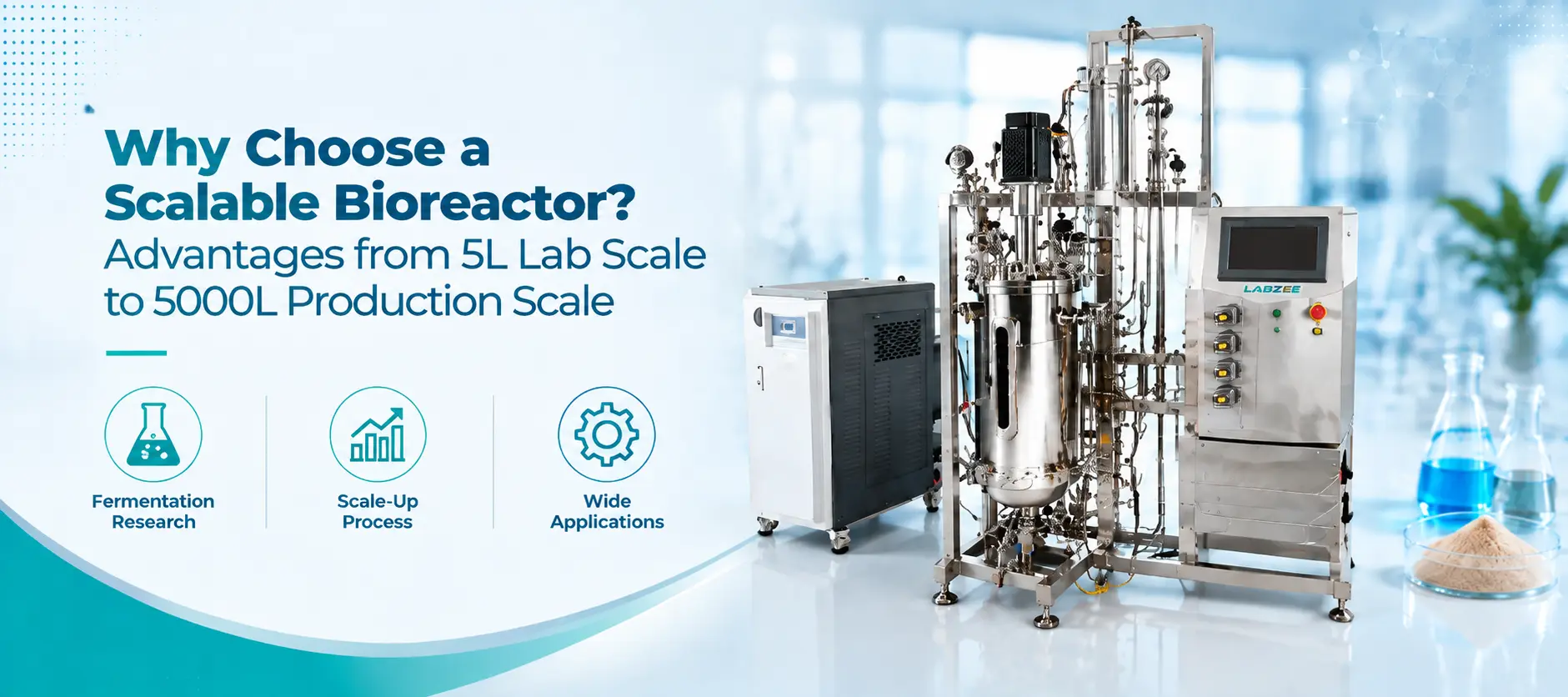
A process rarely stays at the size where it was first developed, and the gap between a bench experiment and a production run is where many programmes lose time. A platform built to grow with the work closes that gap. This guide sets out what a scalable vessel brings across the range, with the Stainless Steel Bioreactor BZLB-501 as a reference point throughout.
Scalability is not just a bigger tank. It means a family of vessels that share the same geometry, agitation approach and control logic, so a recipe proven in a small unit behaves the same way as the volume climbs. When a lab bioreactor and its production sibling are built to one design language, the culture sees the same conditions at 5 litres and at 5000, and the work of moving up becomes adjustment rather than reinvention.
That shared design is why a scalable stainless steel bioreactor is treated as a platform rather than a single instrument. The mechanics that carry across sizes, described next, are what turn a good bench result into output a team can count on at volume.
Diagram: one design carried across 5L, 50L, 500L and 5000L vessels
Add a scale ladder showing matched geometry across volumesThe payoff shows up at each handover between development and manufacturing.
Matched geometry means results track from one size to the next, so surprises at volume grow rarer.
Shared design shortens the handover from development to pilot and production teams.
One control logic and set of procedures span the range, so training and data carry over.
Fewer changes between sizes means fewer variables to chase when a larger batch drifts.
Scalability rests on holding a few relationships steady as the vessel grows, rather than copying settings outright.
Keeping ratios such as vessel height to diameter and impeller to tank size means mixing patterns look alike across the range.
Holding oxygen transfer and power per volume in range keeps an aerobic culture fed the same way at each size.
The same pH, oxygen and temperature loops on each vessel let a proven recipe run unchanged in its logic as volume rises.
Across the range each size has a role, and a scalable family lets a process move between them without changing its character. A 5 litre bench unit suits screening and recipe development, mid-size vessels around 50 to 500 litres serve as seed and pilot stages, and a 5000 litre tank carries production. A seed train may even mix seed bioreactor stainless steel and single-use stages before the main vessel, while the design language stays consistent throughout.
Because the steps share geometry and control, a fermentation bioreactor recipe validated in the pilot stage reaches the production tank with far less rework than a set of mismatched, standalone units would allow.
A platform only pays off when the pieces are chosen to work as one. A few missteps break the chain.
Combining tanks with different geometry across the range reintroduces the scale-up guesswork the platform was meant to remove.
A larger tank that cannot match oxygen transfer starves the culture, so size the transfer to the load, not only the litres.
Jumping straight from bench to production skips the seed and pilot steps where scale problems surface cheaply.
Different control logic on each vessel forces re-validation at each step and erases the data continuity that scale-up depends on.
The Stainless Steel Bioreactor BZLB-501 belongs to a wider category of bioprocessing vessels used to grow cultures under controlled conditions, offered in steel, glass and single-use formats and across a spread of working volumes. When teams weigh options here, they look closely at how well the sizes share a design, alongside agitation and aeration capacity, the control loops on offer, and cleaning and sterilisation features.
You can see how Labzee groups its instruments across laboratory disciplines on the Labzee home catalogue, while the full spread of vessel sizes and formats is laid out on the bioreactor category page for side-by-side review. Comparing the range first makes it easier to line up a scale path with the process a team plans to run.

A short comparison shows why a shared design changes the path to production, whether a team builds one platform or assembles separate tanks from the Labzee bioreactor range.
| Consideration | Scalable platform | Mismatched standalone units |
|---|---|---|
| Scale-up | Predictable across matched sizes | Re-worked at each new tank |
| Tech transfer | Fast, shared design and logic | Slow, translated between designs |
| Training | One approach across the range | Relearned per vessel |
| Data continuity | Comparable records at each size | Fragmented across systems |
| Suited to | Programmes headed for production | One-off, single-scale studies |