Why Thick Pastes Resist Ordinary Mixing
Dry pigments and fillers are supplied as agglomerates: tight clusters of primary particles held together by surface forces. A propeller or paddle mixer moves the liquid around those clusters but cannot supply enough local stress to split them. In a high-viscosity paste the situation is worse, because the medium is too thick to circulate, and the clusters simply sit in it.
Three things have to happen for a good dispersion. The liquid must wet the particle surfaces, the clusters must be broken by mechanical stress, and the separated particles must be kept apart by the formulation. Wetting and stabilization depend on chemistry, while breaking is purely mechanical. A triple roller mill is one of the few laboratory machines that delivers that stress with adjustable control over how much is applied, which makes it a practical tool for high-viscosity homogenization.
How Three Rollers Turn a Paste into a Smooth Film
A laboratory three roll mill has three horizontal rollers mounted side by side. Material is placed in the hopper formed between the feed roller and the center roller. The rollers turn toward each other in neighboring pairs, and each runs faster than the one before it. Speed ratios differ between models, for example 1:3:9 or 1:2:4. The paste is drawn into the first narrow gap, sheared, carried on the center roller into the second gap, sheared again, and finally lifted off the fastest roller by a scraper blade.
slowest
medium
fastest
Triple roller mill diagram: three rollers turn in alternating directions, the hopper sits above the first gap and a scraper blade lifts the film off the apron roller.
1. Charge
Paste is loaded into the hopper
2. First gap
Clusters are sheared between feed and center rollers
3. Second gap
A faster, thinner film is sheared again
4. Scrape off
A blade lifts the film for another pass or collection
Diagram: path of the material from hopper to scraper.
The Numbers Behind Shear: Gap, Speed and Roller Diameter
Dispersion intensity on a three roller mill is easier to control once the basic relationships are clear. The shear rate in a gap depends on how much faster one roller surface moves than its neighbor and on how narrow the gap is. Roller surface speed follows from diameter and rotation rate. The relationship below is a simple approximation, but it explains why the adjustable roller gap is the main control on a three roll mill.
Surface speed v = π × D × n ÷ 60 v₁ and v₂ are the surface speeds of two neighboring rollers in m/s, h is the gap in meters, D is the roller diameter in meters and n is the rotation rate in revolutions per minute.
As an illustration of the triple roller mill formula, a surface speed difference of 0.5 m/s across a 20 µm gap gives a shear rate near 25,000 s⁻¹, which is far beyond what a paddle mixer produces in a thick paste. Halving the gap doubles the shear rate for the same speeds, and this is why successive passes are made with a progressively narrower setting. Actual stress also depends on viscosity, so a thicker paste experiences a higher shear stress at the same shear rate.
Pigment Grinding for Inks and Cosmetics
Color strength, gloss and transparency all depend on how finely pigment agglomerates are reduced, which is why a three roll mill for pigment grinding is a common instrument in printing ink and cosmetic laboratories. Laboratories use it for pigment dispersion, preparing a concentrated pigment paste, or mill base, that is later let down with more binder or vehicle.
Progress is normally checked with a grind gauge, where a drawdown of the paste shows the size at which scratches or specks first appear. The usual practice is to make a first pass with a wider gap to avoid forcing large agglomerates through, then tighten the gap on later passes until the gauge reading stops improving.
Diagram: illustrative reduction in largest particle size over successive passes. Bar widths are schematic, not measured data.
Another triple roller mill application is color matching, where teams value the machine because it handles very small batches. A few tens of grams can be dispersed and compared against a reference, which saves material during formulation work.
Ointments, Creams and Pastes in Pharmaceutics
The triple roller mill in pharmaceutics is used mainly for semi-solid dosage forms. A three roller ointment mill reduces the size of particles suspended in a fatty or aqueous base, spreads the active ingredient and excipients evenly through it, and removes the gritty feel that undispersed solids cause. Formulation research centers, quality laboratories and pharmaceutical R&D teams use it for ointments, creams and similar topical products.
Uniform content
Shear spreads the active ingredient through the base, which supports consistent content from the first gram to the last.
Cleanability
Rollers must be wiped and cleaned between batches to prevent carry-over, so access to the scraper and roller surfaces matters.
Heat sensitivity
Friction warms the film, so heat-sensitive actives or low-melting bases call for short residence times and careful temperature checks.
Because the roller gap is adjustable, the laboratory can narrow it gradually, and the finished semi-solid is then checked by microscopy or a suitable particle test against the laboratory's own specification.
Lubricants, Waxes and Specialty Chemicals in R&D
Beyond pigments and ointments, a three roll mill is used for other thick, high-viscosity materials, including lubricants, waxes and specialty chemicals. In research and development, the same adjustable shear that breaks pigment agglomerates gives repeatable dispersion, which makes test samples from different batches easier to compare. This matters most when a laboratory is screening formulations and needs the dispersion step to stay constant.
Hard or abrasive solids wear roller surfaces, so the roller material (stainless steel or zirconia) should be matched to the formulation, and the rollers should be inspected regularly.
Operating Habits That Protect the Rollers and the Result
Consistent results from a laboratory three roll mill come from a short routine that the whole laboratory follows:
- Pre-wet the powder. Mix the pigment or filler into the base by hand or with a slow stirrer first, so the mill receives a paste and not loose dry powder.
- Open the gap before loading. Start wide, then close it gradually, because forcing hard lumps through a tight gap can damage the roller surface.
- Watch the temperature. Friction warms the film, so look for signs of overheating, such as thinning or odor, and use roller cooling where the unit has it.
- Record the settings. Note gap, speed, batch mass and number of passes with the result, so that a good batch can be repeated.
- Clean promptly. Wipe the rollers and scraper with a suitable solvent or cleaner before the paste dries, and inspect the scraper edge for wear.
- Keep hands clear. The nip points trap fingers and clothing, so guards, the emergency stop and training on safe feeding are essential.
Mistakes That Lead to the Wrong Machine
Before shortlisting, it helps to look through the range of laboratory three roll mill models and match each against the materials, batch sizes and cleaning routine the laboratory actually has. A triple roller mill machine holds a film of paste on its rollers at all times, so working volume deserves as much thought as roller size.
Ignoring the smallest batch
Rollers hold a film of paste, so a large machine wastes material when only a few tens of grams are needed for formulation trials.
Mismatching roller material and formulation
Stainless steel and zirconia rollers behave differently, so match the roller material to how abrasive or reactive the material is.
Overlooking gap range and precision
The adjustable roller distance and the roller precision decide how finely and how repeatably settings can be reproduced between operators.
Forgetting temperature
Heat builds in the film, so check how the unit handles it before planning heat-sensitive work, particularly in pharmaceutics.
Neglecting cleaning access
If the scraper and rollers are hard to reach, cross-contamination between colors or formulations becomes more likely.
Treating guards as optional
Nip points are the main hazard, and guards, emergency stops and operator training should be part of any purchase review.
Labzee Three Roll Mill Models at a Glance
The Labzee three roll mill range offers stainless steel or zirconia rollers, different roller precision levels, and manual or digital controls. Two models show how the options differ.
| Model | Roller material | Roller size | Roller precision | Roller distance |
|---|---|---|---|---|
| Three Roll Mill BZTRM-501 | Zirconia | φ50 mm / W150 mm | ≤2 µm | 1–140 µm |
| Three Roll Mill BZTRM-502 | Stainless steel | 150 mm diameter, 300 mm length | 0.8 µm | See product page |
Choosing Between Milling and Dispersing Methods
No single machine suits all materials. The table outlines where a three roll mill sits among other common laboratory methods; the material and the target particle size decide the final choice.
| Method | Strength | Limitation | Suited to |
|---|---|---|---|
| Three roll mill | High shear in a narrow, adjustable gap; handles very thick pastes | Needs a paste consistency; open rollers expose solvents | Pigment pastes, ointments, creams, inks, cosmetics, waxes, lubricants |
| High-speed disperser | Quick wetting and pre-mixing of larger volumes | Limited stress for breaking tight agglomerates | Low to medium viscosity premixes |
| Bead mill | Very fine reduction of pigments in liquid media | Needs a flowable medium and bead separation | Fine pigment slurries and inks |
| Ball mill | Simple, closed, suited to long grinding times | Slower; broader distribution of results | Dry powders and ceramics |
| Mortar and pestle | Small amounts, no equipment needed | Operator-dependent and hard to repeat | Trials on a few grams |
Where the Three Roll Mill Sits in Dispersing Equipment
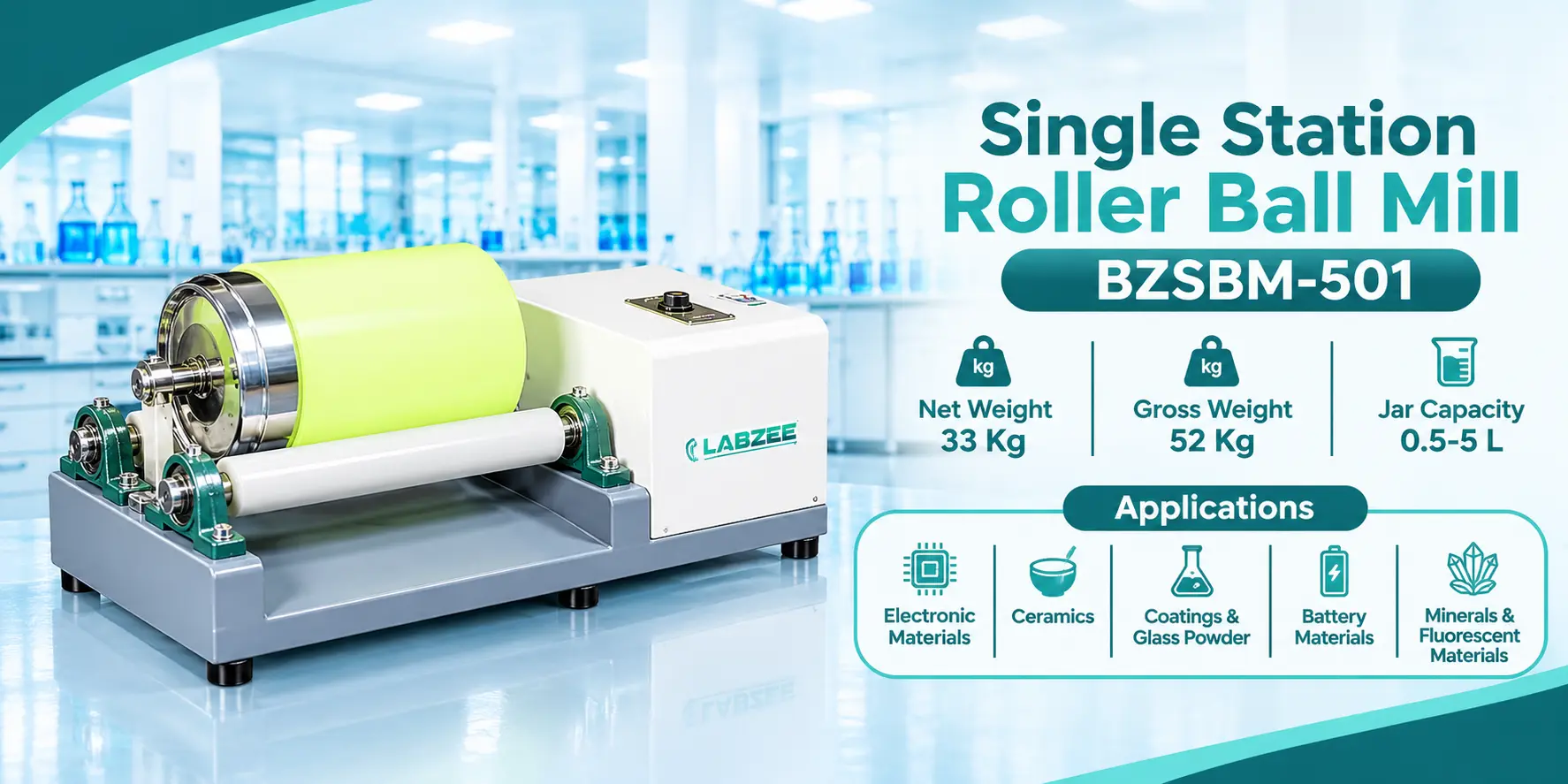
The three roll mill belongs to the family of size-reduction and dispersing equipment, alongside other mills such as the ball mill machine. Within the three roll mill range, buyers usually compare roller material (stainless steel or zirconia), roller diameter and length, roller precision, the roller distance range, and manual or digital controls. All the models can be viewed together on the Labzee three roll mill category page.
A laboratory fitting out a formulation area may also want to see which other instruments are available, and the Labzee home page shows how those categories are laid out .
Sophia Parker
Laboratory Equipment Technical Writer
BIO: Sophia Parker develops technical and content focused on laboratory equipment, scientific applications, and laboratory workflows. Her work involves researching equipment functions, applications, specifications, and practical laboratory use cases.
Areas Covered: Laboratory Equipment • Scientific Applications • Technical Research • testing equipment • Scientific Content
https://www.linkedin.com/in/sophia-parker-46770243b