How Rolling Jars Turn Into Fine Powder
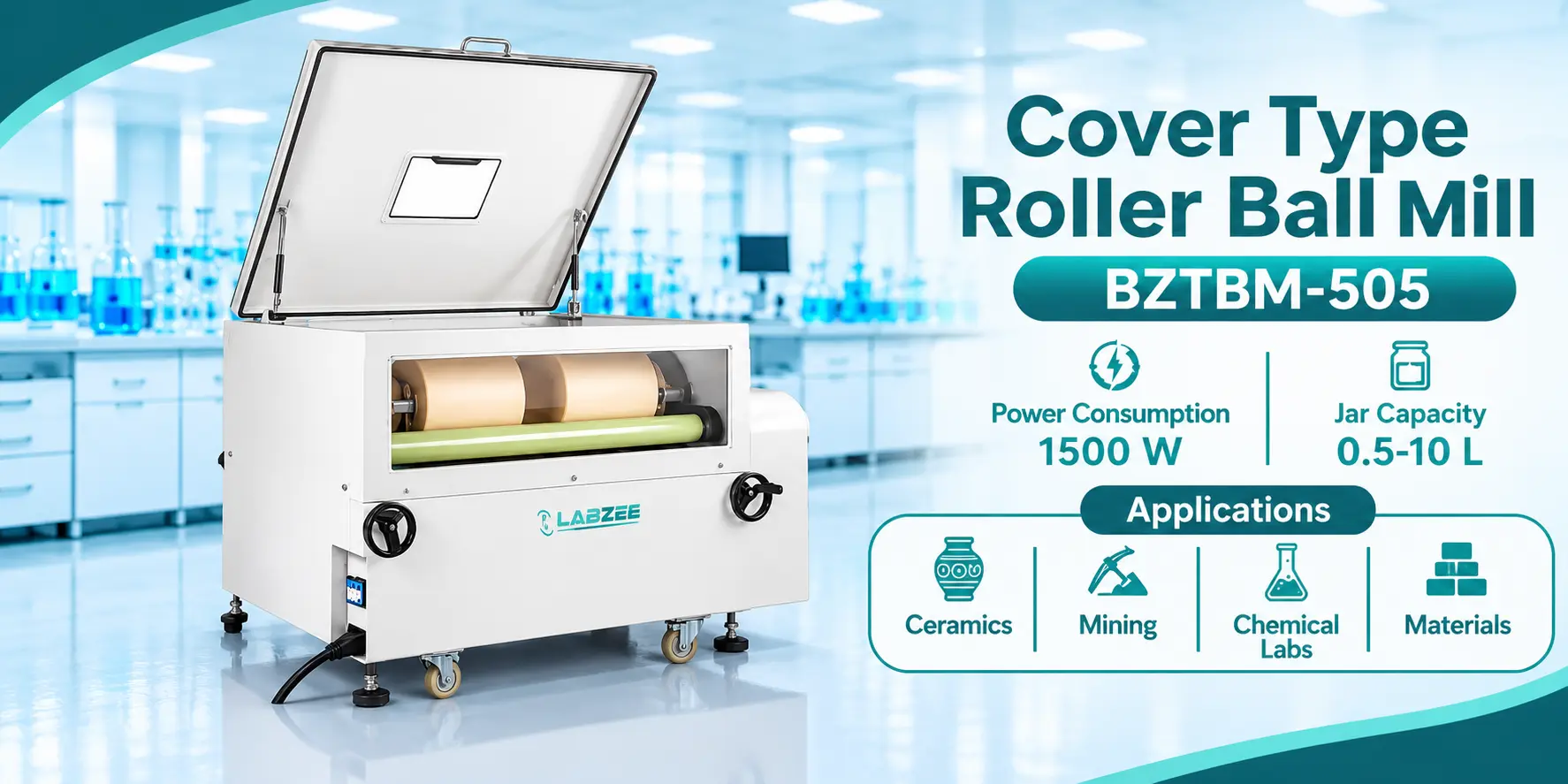
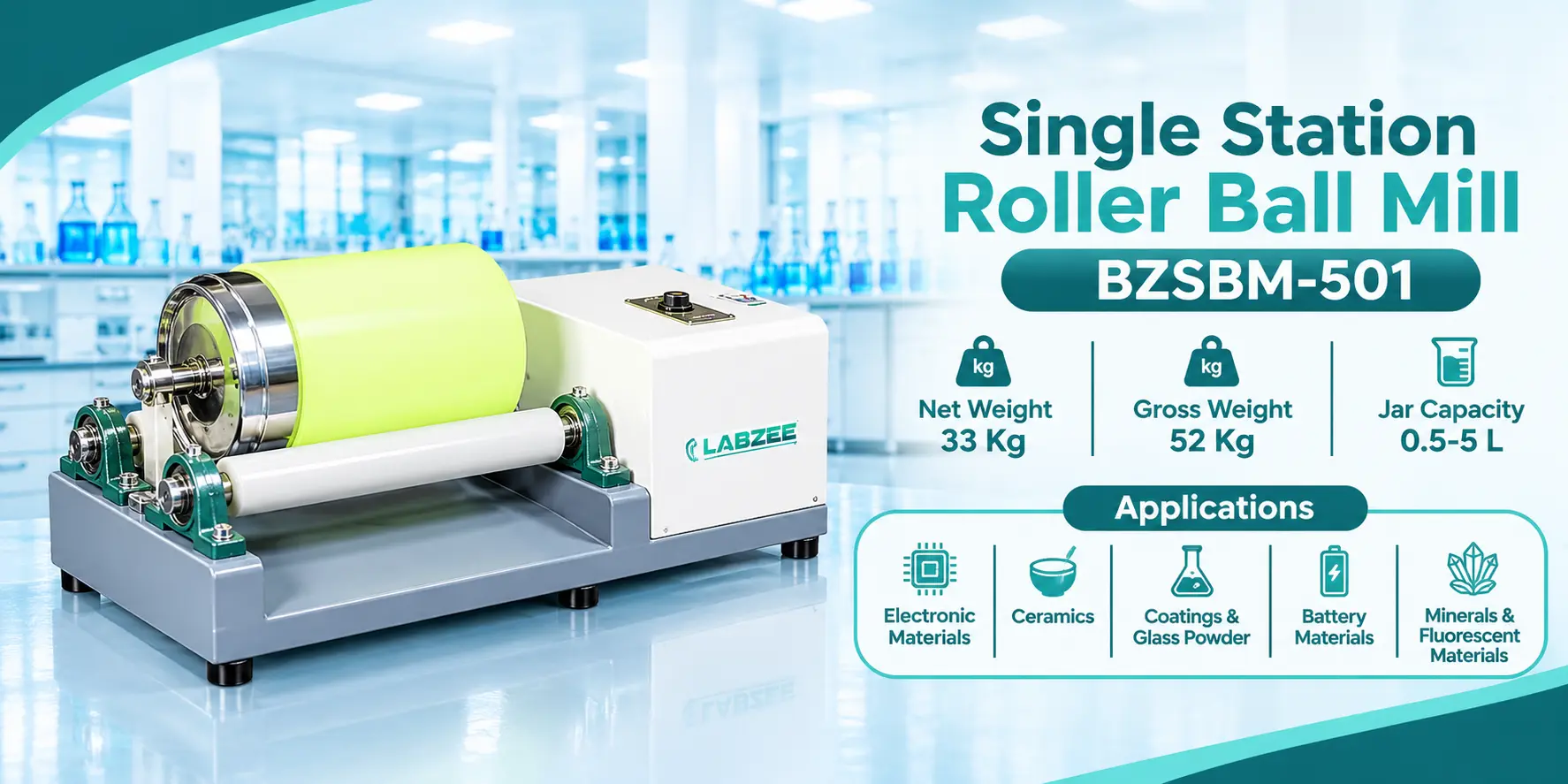
A jar rolling mill rests a closed jar on two parallel rollers. One roller is driven by a motor, and friction turns the jar so that its contents tumble continuously. The Single Station Roller Ball Mill BZSBM-501 has one grinding station and accepts jars across a range of capacities, and its listed details are available on the BZSBM-501 product page.
The single station roller ball mill diagram below shows the sequence from loading to recovery.
What happens inside the jar depends on how fast it turns. At lower speeds the media cascade down the surface of the charge, and attrition between balls and powder does most of the work. At higher speeds the media are carried further up and fall as a cataract, which adds impact. Speeds close to the critical value pin the media to the wall and stop useful grinding, so adjustable speed is a practical need rather than a convenience.
Research Areas That Use Roller Milling
A laboratory ball mill of this type is chosen when gentle, steady tumbling suits the sample better than high-impact milling. The fields below use the same motion for different purposes.
Mining & Mineral Analysis ⛏️
Ore, rock and concentrate samples are reduced to a fine, even powder before assay or phase analysis, so that the small portion tested represents the whole sample.
Ceramics & Glaze Labs 🏺
Oxide powders, frits and glaze slips are milled to control particle size distribution, which affects packing, firing behaviour and surface finish.
Pharmaceutical & Chemical R&D 💊
Early formulation work uses gentle milling and blending to prepare powder batches, with sealed jars helping to limit contamination between trials.
Nanomaterial Development 🧪
Research groups use long, low-intensity runs with small media to deagglomerate and disperse precursor powders and suspensions.
Soil & Environmental Samples 🌱
Dried soil, sediment and waste samples are made uniform so that subsampling for chemical testing gives consistent readings.
Coatings & Pigment Research 🎨
Pigments and fillers are dispersed in liquid carriers, with the rolling jar giving steady shear while small media break up clumps.
Grinding, Mixing and Homogenizing: Choosing the Mode
The same jar can serve three different jobs, and each one calls for a different set-up. Confusing them is a common reason for poor results.
Process Variables That Shape the Result
Operators of a single station roller ball miller can change several settings, and recording them for each run makes results repeatable.
Selection Mistakes Labs Often Make
Picking a laboratory roller mill on one figure tends to cause trouble once real samples arrive. These patterns appear most often during evaluations.
- Choosing by jar volume alone and overlooking how single station roller ball mill design affects roller spacing, load rating and jar stability.
- Assuming a mini ball mill with small jars will scale to the batch sizes the lab later needs.
- Ignoring speed adjustment range, which limits how well the mill can switch between gentle blending and finer grinding.
- Buying for one jar material and finding later that it contaminates sensitive samples.
- Forgetting noise, vibration and bench loading until the mill is already in the room.
- Judging a model without reviewing the single station roller ball mill options against the sample volumes and materials the lab handles.
Roller, Planetary and Mortar Methods Compared
The table shows how three common size-reduction methods differ in a laboratory setting.
| Aspect | Hand mortar | Roller ball milling machine | Planetary mill |
|---|---|---|---|
| Energy input | Low, manual | Gentle to moderate | High |
| Typical fineness | Coarse to fine | Fine | Fine to ultrafine |
| Batch volume | Very small | Small to large jars | Small jars |
| Run duration | Short, hands-on | Hours, unattended | Minutes to hours |
| Heat and noise | None | Low | Higher |
| Typical task | Quick crushing | Mixing and steady grinding | Mechanical alloying |
Safe Operation and Care
A roller mill is simple to run, but a few habits protect both the operator and the sample.
- Check lids, gaskets and jar walls before each run, since a loose lid on a wet jar leaks when it rotates.
- Load the rollers evenly and keep jars within the rated capacity so the drive is not strained.
- Open jars carefully after milling, as fine powder may be airborne, and use ventilation or a dust mask where needed.
- Clean jars and media between samples, and keep a log of materials used in each jar to avoid cross-contamination.
Understanding the Single Station Mill Category
Single station roller ball mills belong to a family of laboratory jar mills that also includes double and multi-station formats. The single station layout suits labs that process one jar at a time and want a compact footprint. Buyers usually compare jar capacity, speed range, drive type, roller size, noise, footprint and available jar materials.
You can browse the full single station roller mill category to see how these attributes differ between models, and learn more about the supplier on the Labzee home page.
Putting a Roller Milling Routine Together
Begin with the material and the goal, whether that is grinding, mixing or homogenizing, then choose a jar, media and speed that suit it. Record each run and change one variable at a time. A laboratory jar mill used this way gives steady, repeatable powders, and a sample record makes unexpected results easier to trace.
Sophia Parker
Laboratory Equipment Technical Writer
BIO: Sophia Parker develops technical and content focused on laboratory equipment, scientific applications, and laboratory workflows. Her work involves researching equipment functions, applications, specifications, and practical laboratory use cases.
Areas Covered: Laboratory Equipment • Scientific Applications • Technical Research • testing equipment • Scientific Content
https://www.linkedin.com/in/sophia-parker-46770243b