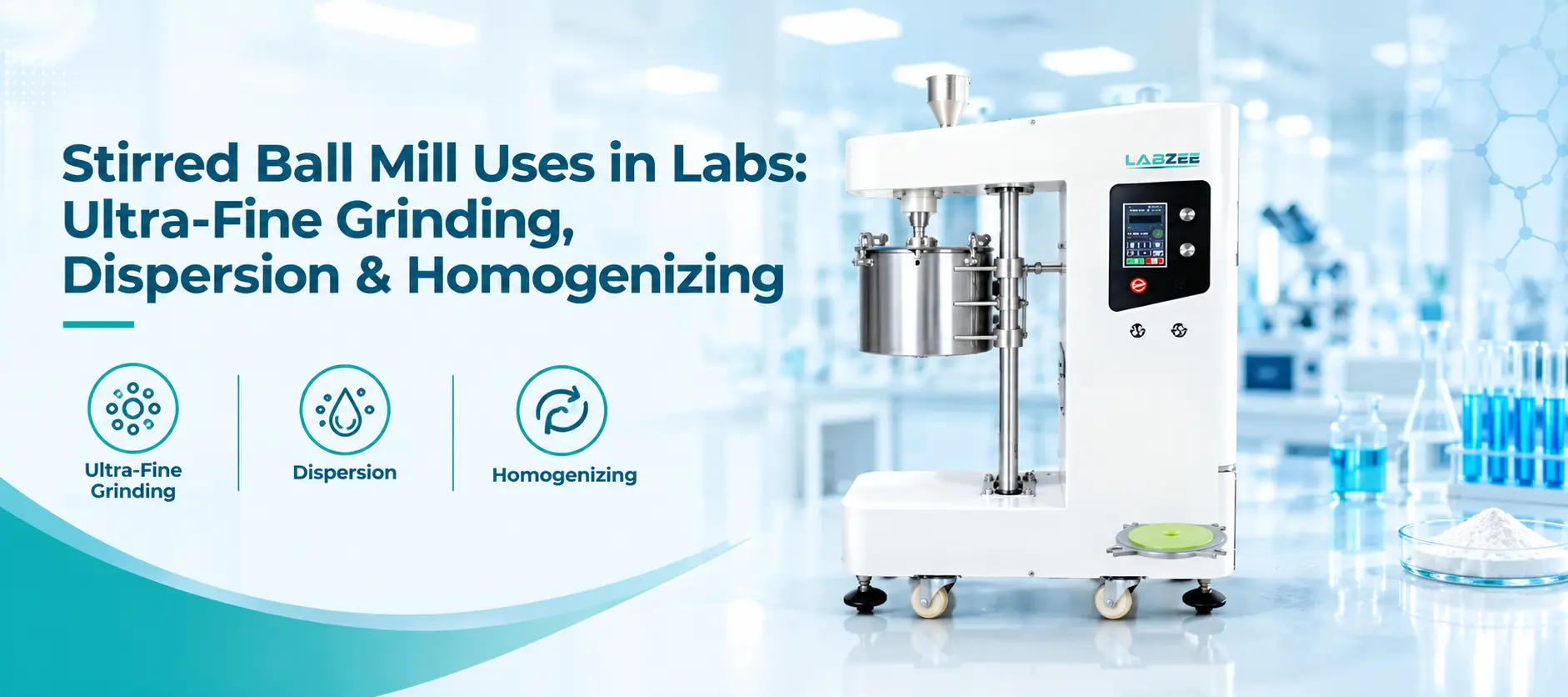
Getting a material down to a coarse powder is one problem; getting it down to a consistent, sub-micron particle size is a different one entirely, and it usually calls for different equipment. A stirred ball mill is built for that second problem, using an internal agitator rather than tumbling action to drive fine grinding and dispersion. This article covers how that mechanism works and where it fits into lab workflows, using the Stirred Ball Mill BZSJM-501 as a working example.
The BZSJM-501 uses a motor-driven agitator to stir grinding media and material together inside a sealed chamber, rather than rotating the entire vessel the way a tumbling mill does. That agitation creates a high-shear mixing zone where stirred balls repeatedly collide with the material, breaking particles down through impact and friction. Stirring speed is adjustable from 0 to 1000 rpm, and a water cooling cycle manages the heat that intense agitation generates, which matters because sustained high-shear grinding can raise chamber temperature enough to affect sensitive formulations if left unmanaged.
Stirred ball mill diagram: agitator shaft, grinding media, and chamber cooling jacket
Add a labelled diagram showing the agitator, grinding media path, and cooling loopA lab ball mill covers a wide range of mechanisms planetary mills rotate a set of jars around a central axis, roller mills turn jars on rollers, and vibrating mills use rapid oscillation but stirred mills, including a stirred media mill like the BZSJM-501, apply force through an internal agitator working continuously within a stationary chamber. That difference in stirred ball mill design is what lets this style of mill sustain very fine particle sizes efficiently at comparatively lower stirring speeds than the high rotational speeds tumbling designs need to achieve similar results. Readers comparing a stirred mill against these other formats can review mechanism and capacity details on the Labzee ball mill machine category page.

| Specification | Value |
|---|---|
| Grinding tank volume | 2 L |
| Charging capacity | 660 ml |
| Stirring speed range | 0–1000 rpm |
| Power consumption | 1500 W |
| Cooling method | Water cooling cycle |
| Dimensions (W×D×H) | 78 × 55 × 132 cm |
| Net weight | 130 kg |
| Gross weight | 183 kg |
The Labzee ball mill machine category page lists a wide range of formats beyond the stirred design covered here, including planetary, roller, vibrating, and three-roll mills, each suited to different sample types and particle size targets. Buyers typically compare grinding mechanism, tank or jar capacity, and speed range before choosing between them. Labzee's broader catalog of laboratory instruments beyond milling equipment is available from the Labzee home page.