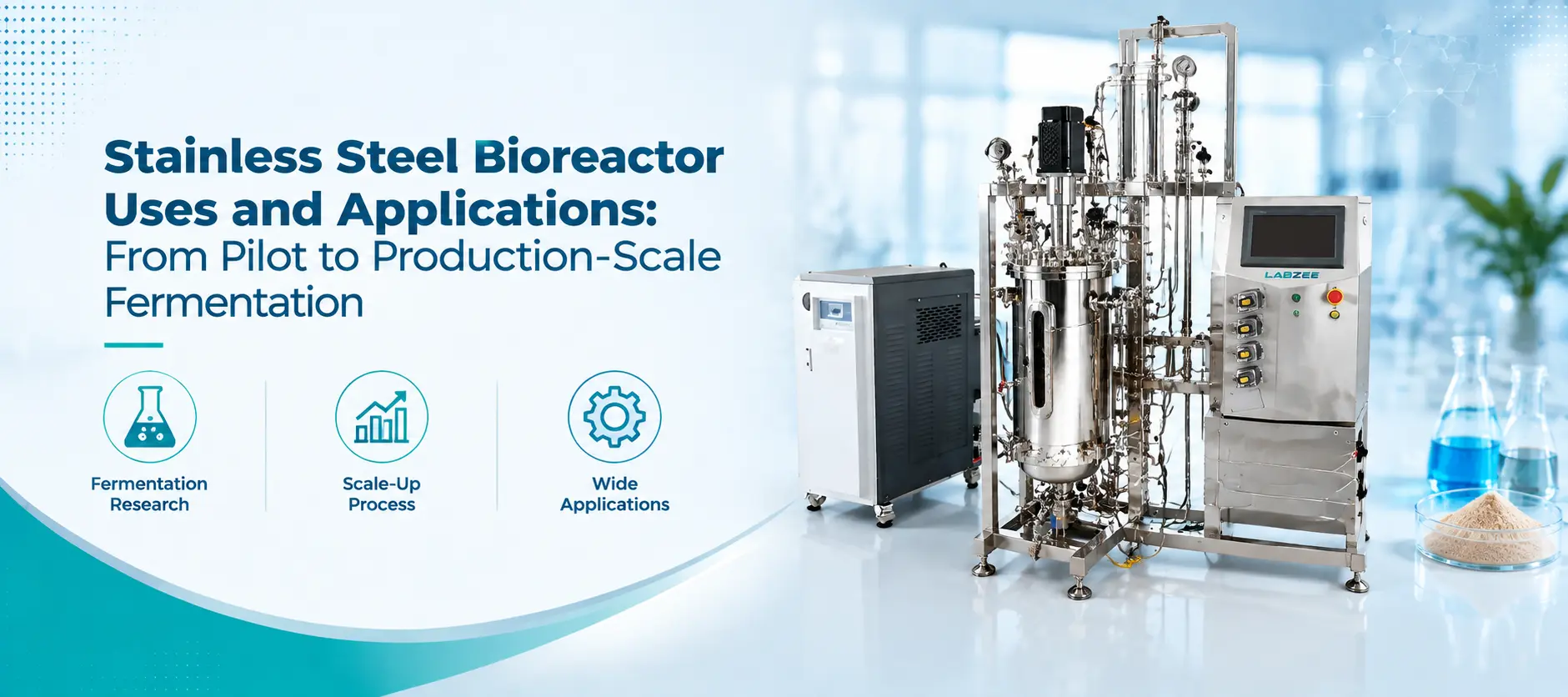
A culture only performs as well as the vessel that holds it, and moving a process from a small pilot run to full output depends on a tank that keeps conditions steady as the volume grows. This guide walks through how these vessels are used across fermentation and what changes on the way up in scale, with the Stainless Steel Bioreactor BZLB-501 as a reference point throughout.
A stainless steel bioreactor is a sealed, jacketed tank that grows a culture under set conditions while probes and controllers hold those conditions in place. Stainless steel is picked for the body because it takes repeated cleaning and steam sterilisation without wear, resists the acids and bases used to correct the broth, and carries the mechanical load that a large working volume brings. Those traits are what let a bioreactor fermenter run batch after batch at scale.
Because the tank is a working part of the process rather than a passive container, its layout of ports, probes and utilities shapes how well a run holds its setpoints. A well-planned stainless steel bioreactor design keeps sensors in well-mixed zones and leaves clear routes for cleaning, both of which matter more as the vessel grows.
Diagram: jacketed vessel with impeller, sparger, probes and utility ports
Add a labelled stainless steel bioreactor diagram of the main assembliesSteady output rests on three systems working together inside the tank.
Impellers keep the broth uniform so cells, nutrients and gases meet evenly, without shearing the culture.
A sparger feeds air or oxygen as fine bubbles, and mixing raises the oxygen transfer the culture needs.
A heating and cooling jacket, with pH, oxygen and temperature loops, holds each setpoint through the run.
Managed together, these systems keep the culture in its productive window, which is the groundwork for the applications that follow.
The same platform supports a broad spread of bioprocessing across research and manufacturing.
Growing bacteria and yeast for organic acids, amino acids, proteins and other products.
Culturing mammalian and insect cells for vaccines, antibodies and therapeutic proteins.
Producing cultures, flavours and fermented ingredients under controlled, repeatable conditions.
Fermenting production strains for industrial enzymes, bioethanol and related outputs.
The jump from pilot to production is where a fermentation bioreactor is truly tested, since conditions that hold in a small tank do not carry over on their own. Growth moves stepwise through a seed train, and a modern train may combine seed bioreactor stainless steel and single-use stages before the culture reaches the main vessel.
Each stage is sized to inoculate the next at the right cell density, so the culture never sits idle or arrives too thin.
Scale-up keeps parameters such as power per volume, tip speed and oxygen transfer in range, so mixing tracks across sizes.
Clean-in-place and steam-in-place let a large vessel be cleaned and sterilised in position, which grows in importance with volume.
Logged conditions give a trace to compare against the pilot when a larger run drifts, turning a one-off into a routine.
A capable tank still under-delivers when the specification skips over how the culture actually behaves. A few missteps recur.
An aerobic culture starves when aeration and mixing cannot meet its oxygen demand at full volume, so size the transfer to the load.
Impeller choice that suits robust microbes can damage fragile cells, so match the mixing to the culture, not the other way round.
Dead legs and awkward ports trap residue and defeat clean-in-place, so plan cleaning routes when the vessel is specified.
Settings that hold in a small tank rarely transfer unchanged, so re-tune the loops when the process moves up in scale.
The Stainless Steel Bioreactor BZLB-501 belongs to a wider category of bioprocessing vessels used to grow cultures under controlled conditions, from bench units through pilot and production tanks, in steel, glass and single-use formats. When teams weigh options here, they compare working volume, agitation and aeration capacity, the number of control loops, cleaning and sterilisation design, and the material of the body.
You can see how Labzee groups its instruments across laboratory disciplines on the Labzee home catalogue, while the full spread of vessel sizes and formats is laid out on the bioreactor category page for side-by-side review. Reading across the category first makes it easier to line up capacity and control with the process a team plans to run.

A short comparison shows why body material follows the scale and the process, whether a team runs one format or mixes them across the Labzee bioreactor range.
| Consideration | Stainless steel | Glass | Single-use |
|---|---|---|---|
| Typical scale | Pilot to production | Bench to small pilot | Bench to mid scale |
| Reuse | Cleaned and reused for years | Reused, easy to observe | Disposable bag per run |
| Cleaning | Clean and steam in place | Manual or autoclave | None between runs |
| Cross-batch risk | Low with validated cleaning | Low at small scale | Low, fresh contact surface |
| Suited to | Sustained, large-volume output | Visible bench studies | Fast turnaround, many products |