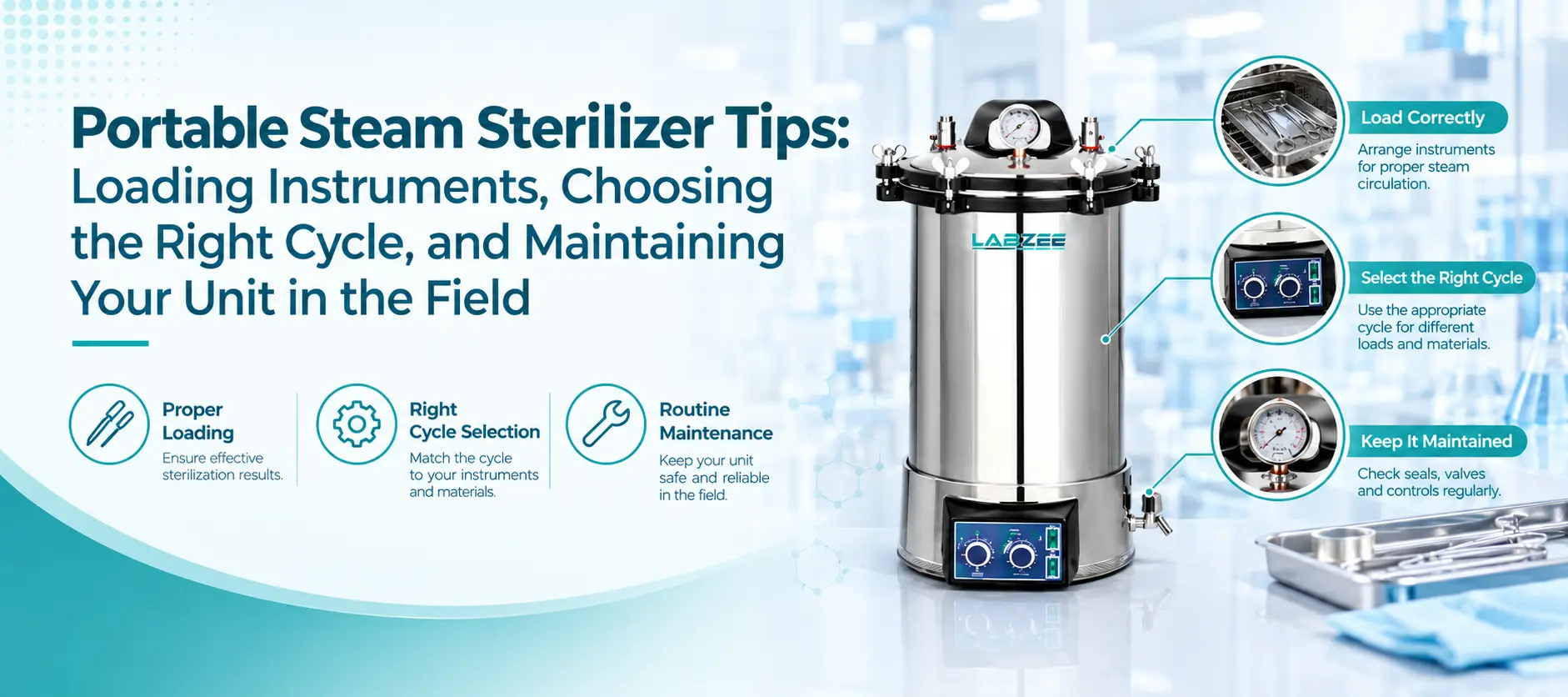
A compact steam unit brings sterilization to clinics, mobile teams, and benches where a full-size chamber does not fit. Getting clean results from one still depends on how instruments are loaded, which cycle is chosen, and how the unit is cared for between runs. This guide covers those points for the Portable Sterilizer Machine BZPS-603, whether it sits on a lab bench or travels to a site.
A portable autoclave sterilizer works on the same physics as a large one: saturated steam under pressure raises instruments to a set temperature and holds them there long enough to kill microorganisms and spores. Water in the chamber is heated until it boils, the rising steam pushes air out, and the sealed vessel builds pressure so the steam can reach sterilizing temperature. As an autoclave medical device in miniature, the portable version trades chamber volume for the freedom to run where mains infrastructure is limited.
The compact size changes a few practical details. A smaller chamber heats and cools faster, holds less water, and is more sensitive to how it is packed, since a single crowded tray can block the steam path. Understanding this is the groundwork for the loading and cycle choices that follow, because a portable steam autoclave rewards careful preparation more than a large chamber with room to spare.
Compact chamber cross-section: water reservoir, steam path, and instrument tray
Add a labelled diagram of air displacement inside a small chamberIn a small chamber, loading is where most results are won or lost. Steam has to reach each surface, so spacing and orientation matter more than in a roomy unit.
Leave gaps between instruments and load to about two-thirds. Packed metal shields inner surfaces from steam and leaves cold spots that never reach temperature.
Unlock jointed instruments so steam reaches the hinge, and tilt bowls or trays so air escapes and condensate drains rather than pooling.
Place wrapped items on edge so steam flows between them, and add a chemical indicator to a representative pack so each run has a check built in.
The right cycle depends on what is inside and how it is wrapped. General instrument loads run around 121 °C, while a shorter, hotter program near 134 °C suits suitable unwrapped items that need quick turnaround. The material always decides, not the clock.
Unwrapped solid instruments tolerate a fast cycle with quick exhaust. Wrapped or pouched items need enough hold and a drying phase, so packs come out dry rather than damp, since moisture compromises the sterile barrier. Any liquids call for a slow, controlled exhaust so they do not boil over as pressure falls. Choosing the program that fits the load, rather than defaulting to one setting, is what keeps a portable sterilizer machine's electronic control panel working for you instead of against the result.
| Load type | Suggested cycle | Exhaust |
|---|---|---|
| Unwrapped instruments | Standard hold, higher setpoint | Fast |
| Wrapped or pouched sets | Standard hold plus drying | Fast, then dry |
| Liquids | Liquid cycle, extended hold | Slow, controlled |
| Mixed small load | General cycle at 121 °C | Fast |
A unit that moves between sites needs a short care routine that a fixed chamber can sometimes skip. These checks take minutes and protect both the cycle and the operator.
Fill with distilled or deionised water and drain the reservoir before transport. Tap water leaves scale that clogs valves and shortens the life of a compact heater.
Wipe the lid gasket, check it for nicks, and confirm the locking mechanism engages fully. A worn seal on a small chamber loses pressure quickly and aborts the cycle.
Keep the steam vent and pressure-release path free of debris, and lift-test the safety valve per the manual so it moves freely after a journey.
Building these habits into how you run portable sterilizers keeps parameters steady from one location to the next, so a field run holds the same standard as a bench run.
Dental, veterinary, and outpatient rooms sterilize instrument sets without space for a floor-standing chamber.
Outreach clinics and site work rely on a unit that runs where fixed infrastructure is thin.
A portable sterilizer machine laboratory teams keep on the bench handles small tool and media loads on demand.
A compact unit covers overflow or downtime when a central chamber is in service or under maintenance.
Buyers often judge a small sterilizer on size alone and miss the details that decide whether it performs in daily use. A few missteps recur.
A portable sterilizer machine for home use or a portable sterilizer machine for car cabin cleaning is built for convenience, not validated instrument sterilization. A portable sterilizer machine in lab settings requires holding temperature and pressure and lets you verify a cycle.
Without chemical and biological indicators, a run is only assumed sterile. Confirm the unit supports the indicators your protocol needs.
A cycle that cannot dry pouches leaves a wet barrier, and a unit that demands frequent water changes slows a busy day. Check both against your workload.
The BZPS-603 belongs to the wider family of steam sterilizers, which spans compact travel units, vertical top-loading chambers, and floor-standing horizontal autoclaves. When laboratories weigh options across this category, they usually compare chamber capacity, temperature and pressure control, drying capability, water handling, and how simply a cycle can be verified. A portable autoclave machine is chosen when mobility and a small footprint outweigh the throughput of a large chamber.
You can see how Labzee arranges its instruments across laboratory disciplines on the Labzee home catalogue, and the full set of chamber types and capacities is laid out on the autoclaves category page for direct comparison. Reading across the category first makes it easier to match capacity, cycle options, and portability to the work a team actually does.

A short comparison helps frame the trade-off between mobility and capacity, and the wider Labzee autoclave range shows where a compact unit sits before you settle on a specific chamber size.
| Consideration | Portable unit | Benchtop or floor chamber |
|---|---|---|
| Footprint | Small, movable | Fixed bench or floor space |
| Capacity | Small loads | Medium to large loads |
| Power and water | Runs where supply is limited | Needs fixed services |
| Turnaround | Fast heat-up, small batches | Longer cycles, larger batches |
| Typical role | Clinics, field, backup | Central sterile supply |




