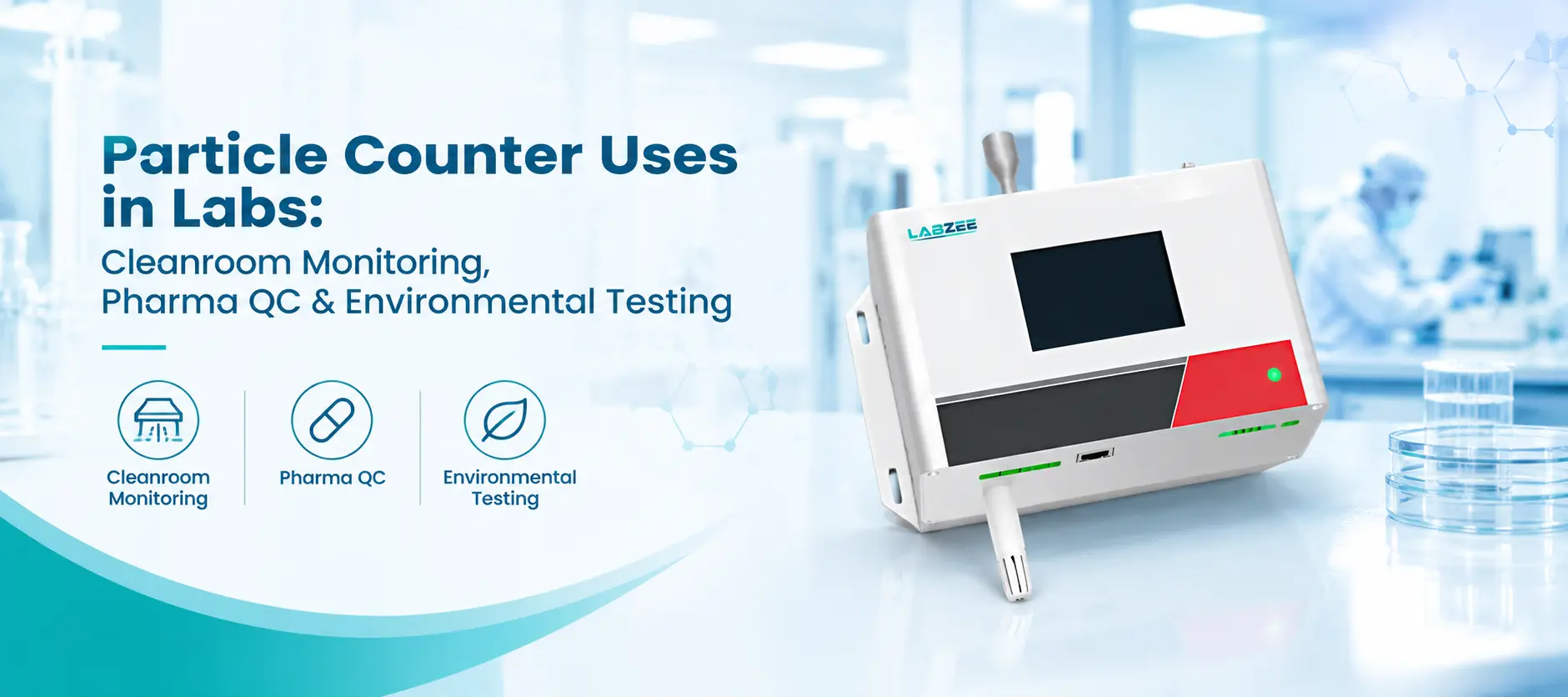
A cleanroom can look spotless and still fail a contamination check, because the particles that matter most are far too small to see. An air particle counter makes that invisible contamination measurable, in real time, across several size ranges at once. This article covers how that measurement works and where it fits into lab and cleanroom operations, using the Airborne Particle Counter BZAP-501 as a working example.
The BZAP-501 draws a sample through an isokinetic sampling probe at a fixed flow rate of 28.3 L/min, then passes it through an optical sensing path that measures how light scatters off each particle. That light-scattering data is sorted into five size channels above 0.3µm, 0.5µm, 1.0µm, 5.0µm, and 10µm and counted at a 1-second data refresh rate, with counting efficiency specified at 50% at the 0.3µm threshold. Isokinetic sampling matters here specifically: drawing air at a speed that matches the surrounding airflow avoids skewing which particle sizes actually reach the sensor.
Particle counter diagram: sample intake, optical sensing path, and size-channel classification
Add a labelled diagram showing the isokinetic probe, sensing chamber, and size channelsThe BZAP-501 displays results against ISO 14644-1 cleanroom classification directly on its 3.5-inch color screen, in either pcs/28.3L or pcs/m³ depending on which unit format the facility standardizes on, and raises visual and audio alarms when a size channel crosses a set threshold. A classification reading is really a snapshot: it confirms the air met a standard at the moment of sampling, not that it will stay there, which is why continuous or scheduled monitoring matters more than a single pass. Facilities comparing monitoring options can review classification and channel specifications across models on the Labzee particle counter category page.
| Specification | Value |
|---|---|
| Sensing method | Optical light-scattering |
| Flow rate | 28.3 L/min |
| Particle size channels | >0.3, >0.5, >1.0, >5.0, >10µm |
| Counting efficiency | 50% at 0.3µm |
| Detection range | 0–1,000,000 particles/28.3L |
| Power-on time | ≤8 seconds |
| Data refresh rate | 1 second |
| Display | 3.5-inch color screen |
| Operating range | 0–45°C, 0–95% RH non-condensing |
| Power supply | DC 24V ±15%, ≤3A |
| Communication | RS485 interface |
| Dimensions (W×D×H) | 202 × 85 × 124 mm |
| Weight | 2 kg |
The Labzee particle counter category page lists several distinct product lines rather than one generic particle counter design: airborne particle counters like the BZAP-501, a benchtop liquid particle counter for samples suspended in water, oil, or other fluids, laser airborne counters, and a portable particle counter built for handheld field use. Buyers typically start by confirming which sample type — air or liquid — and which use pattern — fixed installation or portable — match their need before comparing channel ranges. The wider Labzee catalog of laboratory instruments beyond particle counters is available from the Labzee home page.




