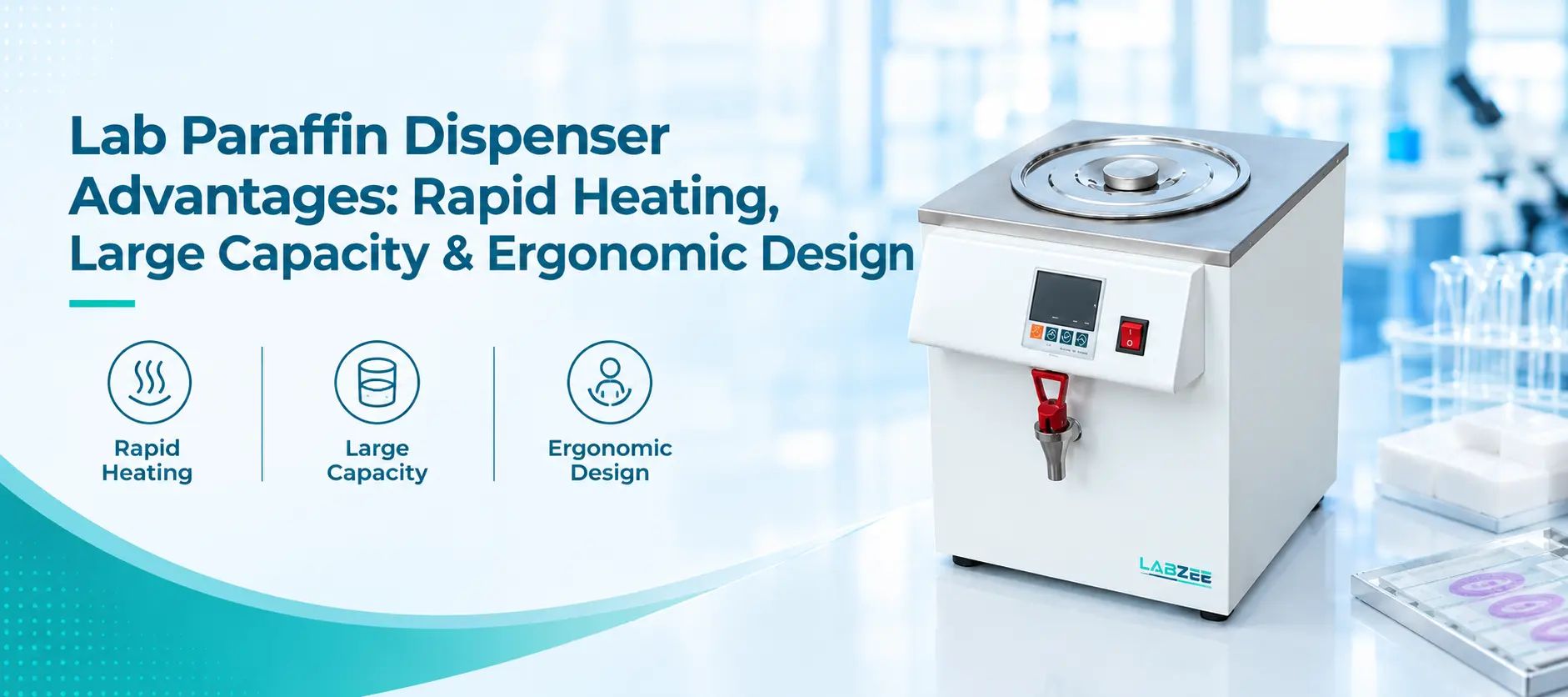
Three figures on a spec sheet rarely get the attention they deserve when a lab is comparing paraffin dispenser uses across models: how fast the unit reaches working temperature, how much wax the reservoir actually holds, and how the dispensing nozzle is positioned relative to the mold. The Paraffin Dispenser BZPD-501 is a useful case for looking at what each of these three factors changes in daily embedding work, beyond what a single headline number communicates on its own.
Shortens the wait between switching the unit on and having usable wax, and shortens recovery time after a lid is left open.
Reduces how often a busy embedding station needs to pause and reload the reservoir mid-shift.
Affects how comfortably and precisely wax reaches the mold, cassette after cassette, over a full working day.
A paraffin wax dispenser machine that takes a long time to bring a full reservoir up to working temperature either has to be switched on well ahead of the first case, or the lab keeps it running continuously to avoid the wait. Labzee's listing for this class of unit cites a heating window in the region of 30 to 60 minutes to reach a usable working temperature, which is a meaningfully different planning constraint than a unit that needs several hours.
That heating speed only holds its value if the temperature control keeps pace once the set point is reached. On the BZPD-501, the working range is adjustable between 50°C and 70°C within an overall ambient-to-70°C span, held to within ±1% — so the reservoir is not just reaching temperature quickly, it is also staying close to the set point rather than drifting once it gets there.
Capacity is usually the first number buyers compare, but it matters most in combination with how a lab actually schedules embedding work. A histology paraffin dispenser sized for a full day's case load means fewer interruptions to top off and re-stabilize the reservoir, which in turn means fewer thermal cycles for the wax already inside it. The BZPD-501's 10-liter reservoir is built for that kind of continuous-use pattern rather than intermittent, small-batch dispensing.
Buyers weighing capacity against bench space and throughput can compare the full range of options on the Labzee paraffin dispenser category page, where reservoir size is listed alongside temperature range and dimensions for each model.
An automatic paraffin dispenser or a manually operated one both depend on the same basic ergonomic factor: how easily wax reaches the mold without the operator having to reposition the unit, lean awkwardly, or fight a nozzle angle that drips onto the bench. At 350 × 450 × 510 mm and 10 kg net, the BZPD-501 is sized to sit within a standard embedding station without crowding adjacent equipment, and Labzee's category listing describes the nozzle as designed for drip-free dispensing rather than requiring a separate catch tray.
Paraffin dispenser drawing: footprint dimensions and nozzle height relative to a standard mold tray
Add a labelled diagram showing the unit's footprint and nozzle reach over a mold trayLabzee's published listing does not specify whether the dispensing path is gravity-fed or includes a paraffin pump dispenser stage; labs specifically evaluating a paraffin bath machine for pump-assisted delivery, including a paraffin wax dispenser in histopathology use with high daily throughput, should confirm that detail directly before purchase.
Hospital-based pathology laboratories and standalone clinical laboratories both run a paraffin dispenser histology station against a fixed daily case schedule, which is exactly where faster heating and larger reservoir capacity reduce downtime between blocks. Research centers preparing sectioned samples in batches benefit similarly, and a histology paraffin wax dispenser sized for continuous use tends to suit a shared, multi-shift bench better than a smaller unit built for occasional dispensing. Teaching labs introducing embedding technique tend to value the ergonomic footprint more than raw throughput, since fewer students are working the station at once.

| Specification | Value |
|---|---|
| Reservoir capacity | 10 L |
| Temperature range | Ambient to 70°C |
| Adjustable working range | 50°C – 70°C |
| Temperature precision | ±1% |
| Power consumption | 1200 VA |
| Voltage options | AC 220V 50Hz or AC 110V 60Hz |
| Product dimensions (W×D×H) | 350 × 450 × 510 mm |
| Net weight | 10 kg |
| Gross weight | 15 kg |
| Packaging | Wooden case |
The Labzee paraffin dispenser category page groups wax dispensing equipment by reservoir capacity, heating speed, and dispensing mechanism, which are the same three factors this article has walked through. Paraffin dispensers sit within Labzee's wider catalog of laboratory instruments — shakers, ovens, refrigerators, stirrers, and ultrasonic cleaners among them — viewable from the Labzee home page for labs equipping more than one department.




