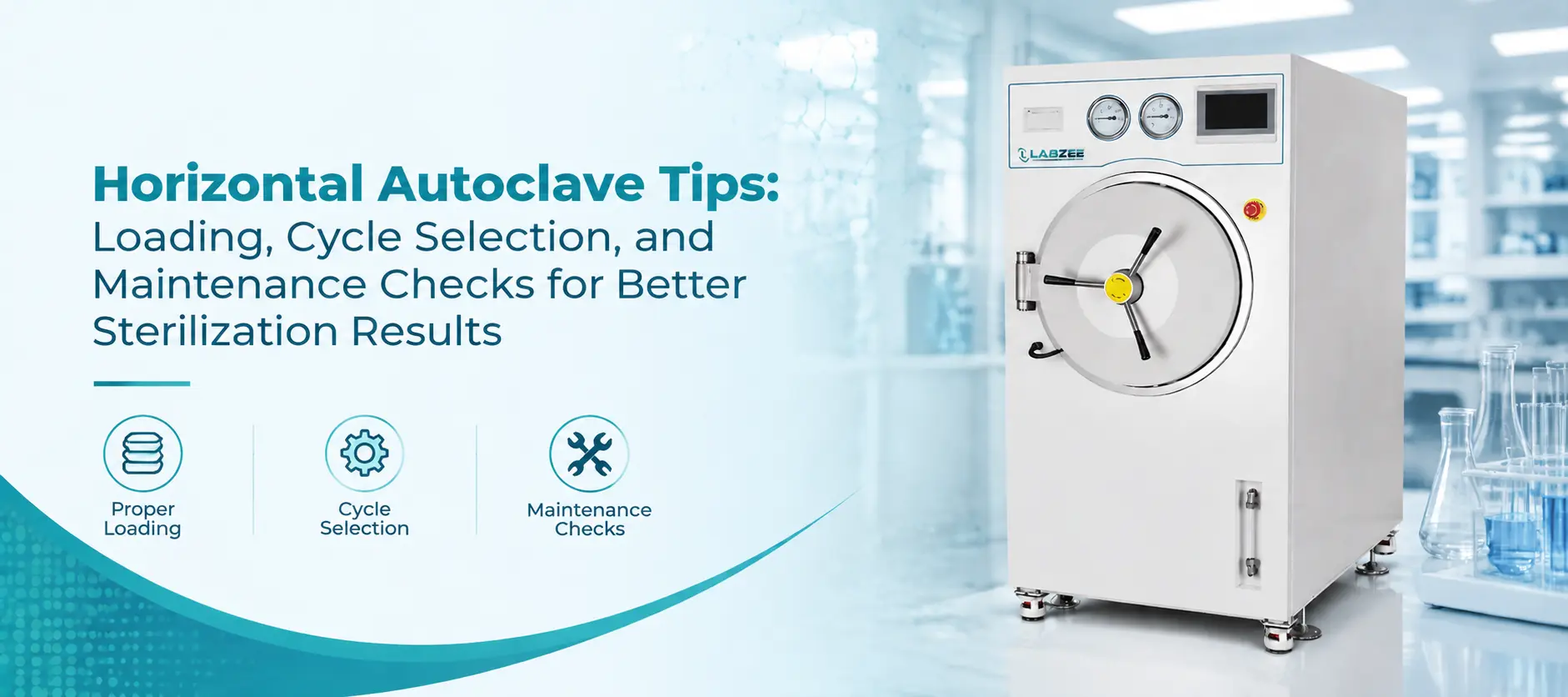
Steam sterilization succeeds or fails on the details an operator controls day to day: how the chamber is packed, which cycle is chosen, and whether routine checks are kept up. This guide covers those practical points for the Horizontal Autoclave BZAH-501, so loads come out sterile, and the machine stays in good working order.
A horizontal steam sterilizer autoclave sterilizes by holding a load at a set temperature under saturated steam pressure for a defined hold time. Steam enters the chamber, displaces the air, and gives up its latent heat as it condenses on the load surface, which is what raises the items to sterilizing temperature. Air is the enemy here: any pocket that steam cannot reach stays cooler and may survive the cycle, so the design of a horizontal autoclave machine centres on moving air out and steam in.
The horizontal layout places the chamber door at the front and the working depth running back along the bench, which suits long or bulky items and lets carts roll straight in. On a horizontal steam sterilizer, the front-loading geometry also makes it easier to arrange trays so condensate drains rather than pooling. Understanding this air-and-steam exchange is the foundation for the loading and cycle choices that follow.
Horizontal autoclave diagram: chamber, jacket, steam inlet, and drain path
Add a labelled cross-section showing air displacement and condensate drainageGood results start with how items sit in the chamber. Steam has to circulate each package, so loading is about leaving space, orienting containers correctly, and keeping materials separated by type.
Load to roughly three-quarters of the chamber and keep a finger's width between items. Tightly stacked trays block circulation and create cold spots that steam never reaches.
Place bottles, beakers, and dishes on their side or inverted so air can fall out and condensate can run off. Upright sealed vessels trap air and hold water that skews the cycle.
Keep glassware, textiles, and waste in separate runs, since each takes up heat differently. Loosen screw caps so pressure equalises and steam can enter the container.
A cycle is a set of temperature, pressure, and hold-time values, and the right one depends on what you are sterilizing. Most laboratory work sits around 121 °C for general loads and 134 °C for faster turnaround on suitable items, but the material decides which applies. A fully automatic horizontal autoclave steps through pre-vacuum or gravity air removal, heat-up, hold, and exhaust on its own once the program is set, which removes much of the guesswork from routine runs. A horizontal autoclave fully automatic in this way also records the parameters of each cycle, so operators can confirm a load met temperature and hold time rather than assuming it did.
Wrapped and porous loads benefit from a pre-vacuum stage that pulls air out before steam enters, while unwrapped solid items can run on a gravity cycle. Liquids need a slow, controlled exhaust so they do not boil over as pressure drops. Choosing an automatic horizontal autoclave program that matches the load type is what keeps a fast textile run from ruining a flask of media, or a liquid cycle from stretching a simple instrument run longer than needed.
| Load type | Suggested approach | Exhaust |
|---|---|---|
| Unwrapped instruments | Gravity cycle, standard hold | Fast |
| Wrapped or porous packs | Pre-vacuum air removal | Fast, with drying |
| Liquids and media | Liquid cycle, extended hold | Slow, controlled |
| Biohazard waste | Extended hold at higher setpoint | Fast |
A short maintenance rhythm keeps sterilization results steady and heads off downtime. These checks take minutes and belong to the operator, not only to the service engineer.
Wipe the gasket and sealing face, look for cracks or debris, and clear the chamber drain and strainer. A leaking seal drops pressure mid-cycle, and a blocked drain traps air.
Check the water supply quality and top up the reservoir as needed. Lift-test the safety valve per the manual, so it is free to move.
Run chemical indicators inside representative packs and biological indicators on the schedule your protocol sets, then log the reading. Verification is the record that a load was actually sterilized, not just processed.
Treating these steps as part of running lab sterilization equipment, rather than as occasional housekeeping, is what separates a machine that holds its parameters from one that drifts.
Horizontal autoclaves run from hospital sterile services through to media prep and waste treatment, and the models grouped in the Labzee autoclave range cover that spread of daily tasks.
Front-loading depth suits instrument trays and wrapped sets moved on carts through central sterile supply.
Batch runs of culture media, flasks, and pipettes rely on liquid cycles with controlled exhaust.
Contaminated waste is rendered safe before disposal using extended holds at a higher setpoint.
A horizontal laboratory autoclave handles mixed daily loads where bench depth and cart access matter.
Buyers often fix on chamber volume and overlook the factors that shape daily use. A few recurring missteps stand out.
An oversized chamber wastes energy and lengthens cycles for the small loads that make up most days. Match volume to typical throughput, with headroom rather than excess.
Gravity displacement handles unwrapped items but struggles with porous packs. If wrapped loads are frequent, a horizontal autoclave machine with an automatic pre-vacuum stage is worth prioritising.
Steam source, water quality, and a proper floor drain all affect installation. Confirm site services early so a chosen unit is not held up by the room it lands in.
The BZAH-501 belongs to a wider family of steam sterilizers that spans bench-top units, vertical top-loading models, and floor-standing front-loaders. When laboratories weigh options across this category, they usually compare chamber orientation, air-removal method, capacity, and degree of automation. Orientation is often the first decision: a vertical autoclave saves floor space and suits flasks and tall vessels, while a front-loading design favours trays, carts, and longer items, which is why many buyers evaluate autoclave horizontal and vertical formats side by side before committing.
You can see how Labzee groups its instruments across laboratory disciplines on the Labzee home catalogue, and the full set of chamber sizes and orientations is laid out on the autoclaves category page for direct comparison. Reading across the category first makes it easier to match capacity, cycle options, and footprint to the work a lab actually runs.

A short vertical and horizontal autoclave comparison helps frame the trade-off: an autoclave machine horizontal in orientation takes trays and carts through a front door, while a top-loader saves floor space, so weigh both before you look at specific chamber sizes.
| Consideration | Horizontal front-loader | Vertical top-loader |
|---|---|---|
| Footprint | Wider bench or floor span | Compact, saves floor space |
| Load handling | Trays and carts roll in | Lowered in from the top |
| Suited to | Long items, wrapped sets, waste | Flasks, bottles, tall vessels |
| Access | Front door at working height | Top lid, reach down to load |
| Typical capacity | Medium to large | Small to medium |




