What "Advanced Vibration" Actually Means for a Sieve Stack
A simple shaker moves a sieve stack in one direction, usually a vertical tap or a horizontal circular sweep. That single motion works for coarse, free-flowing material, but it tends to leave fine or irregularly shaped particles sitting in place rather than moving across the mesh surface. A dual-motion mechanism combines vertical tapping with a horizontal or three-dimensional sweep at the same time, so particles are lifted, redistributed, and carried across the sieve rather than settling into one section of the mesh.
That combined motion is what separates a basic mechanical sieve from one built for both heavy throughput and fine resolution. Amplitude, how far the stack moves on each cycle, and frequency together determine how aggressively material is agitated, and getting that balance wrong is one of the more common reasons two runs on the same sample come back with different numbers.
Diagram placeholder: combined vertical and orbital motion paths acting on a sieve stack
Handling High-Capacity Batches Without Losing Accuracy
Higher batch volumes put more strain on a shaker in ways that are not always obvious from a spec sheet. A heavier load changes how the stack responds to a given amplitude setting, which is why some units that read as accurate on small test samples start to drift once a full-capacity batch is loaded. A sieve shaker machine intended for high-capacity work needs enough motor torque and clamping force to maintain the same motion pattern regardless of whether the sieves are lightly or fully loaded.
Sieve diameter and stack height also come into play here: a taller stack with more sieves distributes weight differently than a short stack with two or three, and the clamping mechanism has to hold that taller assembly firmly enough that vibration does not loosen it mid-run.
Where Precision Screening Raises the Bar
Precision work on fine powders, pharmaceutical intermediates, or research-grade material characterization asks something different of a shaker than high-capacity aggregate testing does. Here, the priority shifts from moving a large volume of material to resolving very small differences in particle size, which means amplitude needs to be adjustable in fine increments rather than set to one or two fixed levels.
A programmable digital timer matters more in this context too, since precision runs are often repeated multiple times on the same sample to confirm a result, and even small variation in run duration between repeats can shift the recorded distribution enough to matter. Laboratories doing this kind of work tend to prioritize control granularity over raw throughput when comparing a laboratory sieve shaker machine.
Where Amplitude and Timer Settings Commonly Get Misjudged
Using one amplitude setting for all material types
Coarse aggregate and fine powder respond differently to the same vibration intensity. A setting that works for one can under-separate or over-agitate the other, so leaving amplitude fixed regardless of sample type is a frequent source of inconsistent readings.
Running high-capacity loads on a low-torque unit
A motor sized for light lab samples can bog down under a full aggregate batch, changing the actual motion delivered to the stack even though the display still shows the intended setting.
Skipping a trial run before a full batch
Jumping straight into a full-volume run without a short trial to confirm settings wastes material when a mismatch between load and amplitude only becomes obvious partway through.
Comparing units only on maximum capacity
A sieve analysis machine rated for a large maximum load is not automatically strong on fine-particle resolution, and the reverse is also true. Checking specifications across the sieve shaker category page against both capacity and amplitude control helps avoid picking a unit suited to only one side of the job.
The Broader Category: Material Screening Machines
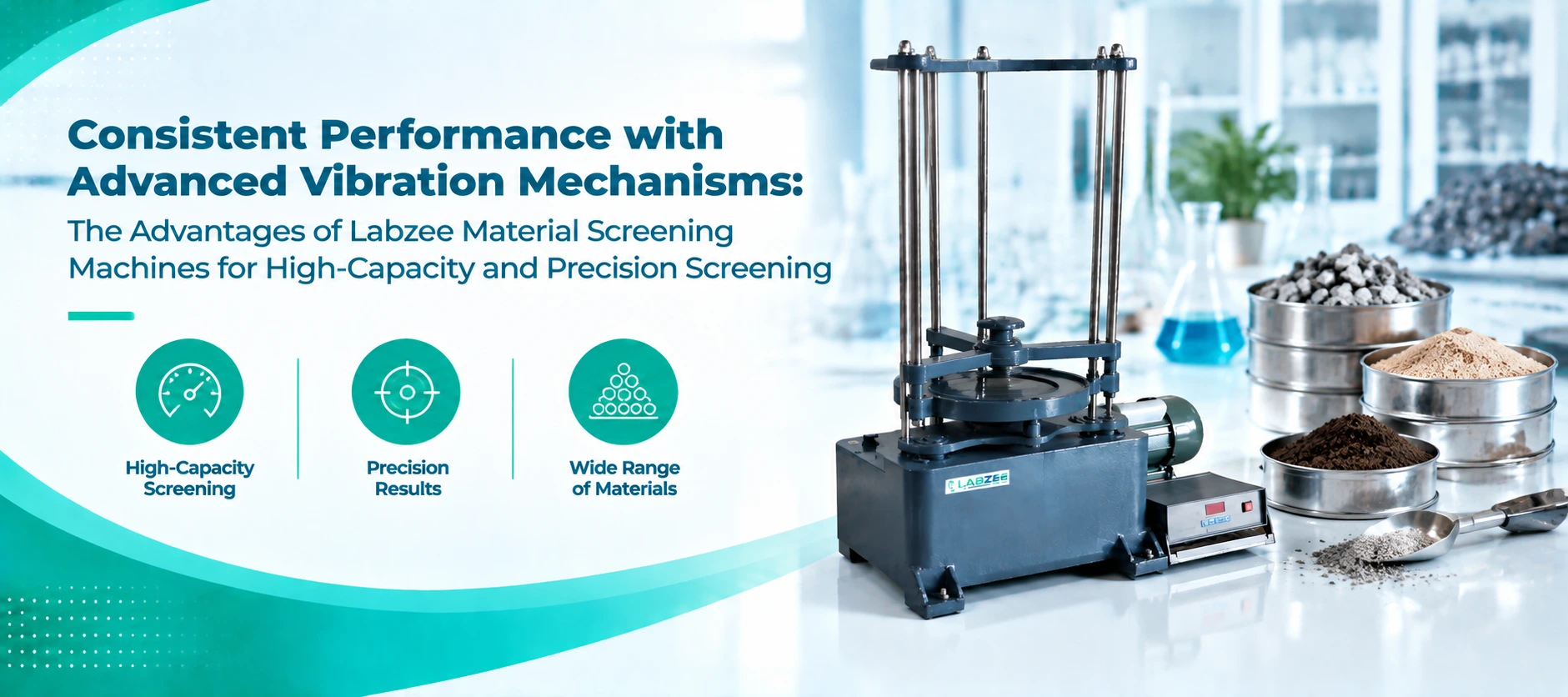
The BZMSH-501 sits within a wider category of material screening machines that ranges from compact single-motion shakers for occasional lab checks to heavy-duty industrial units built around continuous, high-volume throughput. Buyers evaluating this category typically compare motion type, amplitude adjustability, sieve diameter compatibility, clamping strength, and how consistently a unit performs as load size changes.
Browsing the full sieve shaker range side by side makes it easier to line up capacity and precision specifications against actual sample needs, and the broader catalogue of laboratory and material testing equipment can be reviewed from the Labzee home page for context on how screening machines fit alongside other testing instruments.

Fixed-Amplitude Units Compared With Adjustable Vibration Control
A fixed-amplitude shaker offers one or two preset motion intensities, which keeps the control panel simple but limits how closely a run can be matched to a specific material. An adjustable-amplitude unit lets an operator dial in intensity across a wider range, trading some of that simplicity for the ability to fine-tune a run for anything from coarse aggregate to a fine chemical powder.
| Consideration | Fixed Amplitude | Adjustable Amplitude |
|---|---|---|
| Control panel | Simple, few settings | Wider range of settings |
| Material range | Suited to one material type | Suited to varied samples |
| Learning curve | Minimal | Slightly longer |
For a facility running a narrow range of material types, a fixed-amplitude unit may cover most needs without added complexity. For labs handling both high-capacity aggregate checks and fine precision work, adjustable control tends to justify the extra setup time.
Keeping Motion Consistent as a Unit Ages
Vibration mechanisms wear gradually, and the first sign is usually a subtle shift in amplitude rather than a sudden failure; a unit that once separated a reference sample cleanly starts producing slightly different distributions on the same material. Periodic checks against a known reference sample, alongside inspection of motor mounts and clamping hardware for looseness, catch this drift before it affects a full run of production or research data.
Keeping the vibration assembly free of dust buildup also matters, since accumulated fine material around moving parts can dampen motion in ways that are not obvious from the display but do show up in the final size distribution.