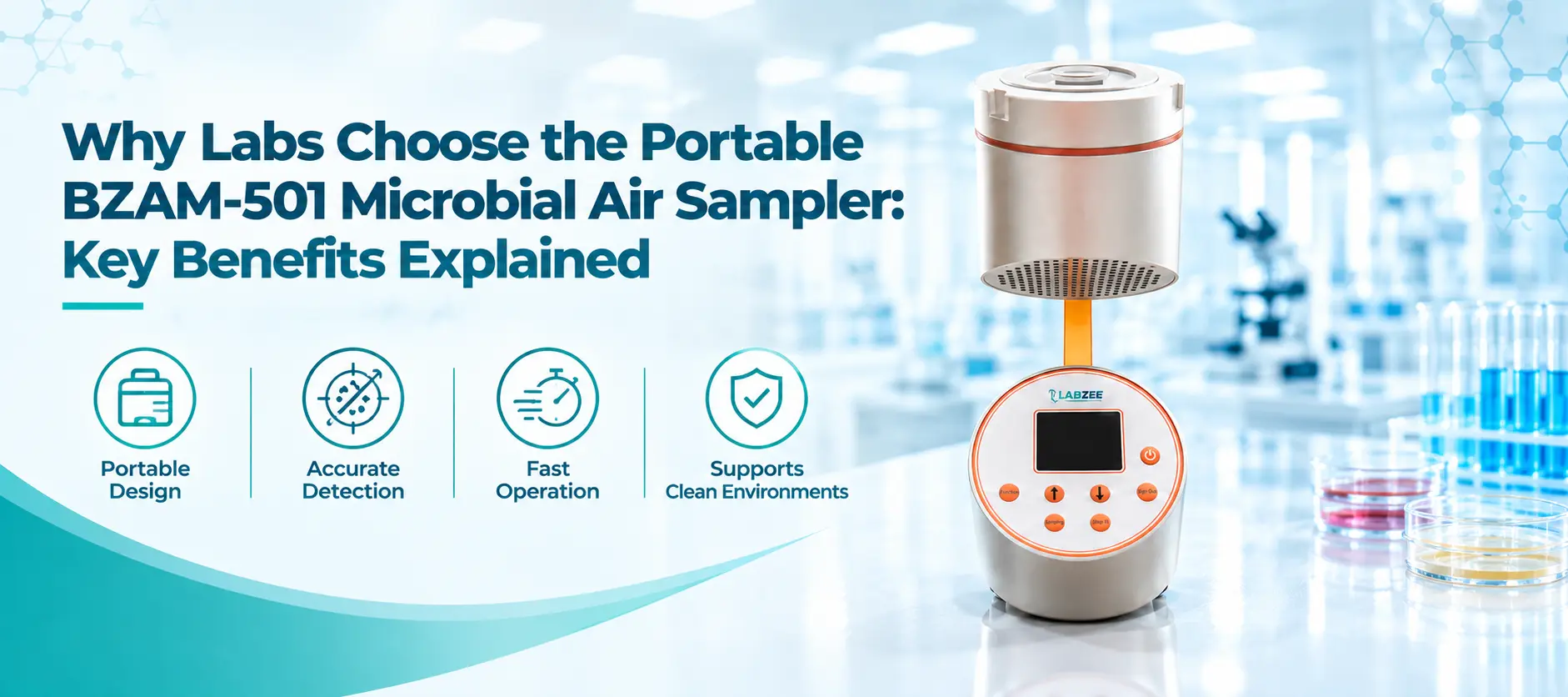
Cleanroom monitoring often means testing several zones in one shift, and equipment that has to stay bolted to one spot slows that process down. A microbial air sampler built to move between rooms changes the math on how much ground one operator can cover. This article looks at three specific benefits behind that choice portability, sampling accuracy, and operational efficiency using the BZAM-501 as a working reference.
Not all air sampling devices are built to travel between rooms during a single shift; many general-purpose units are meant to stay fixed in one location, connected to a permanent power source. As a portable microbial air sampler, the BZAM-501's 5kg net weight and 13×13×30cm footprint let one operator carry it from cleanroom to cleanroom, running a fresh sampling cycle at each stop rather than moving samples to a single fixed station. When comparing air sampling equipment across categories, this kind of mobility often matters as much as raw sampling sensitivity, particularly in facilities that need to validate several zones on a rotating schedule. Weight and battery specifications for portable versus fixed formats can be compared directly on the Labzee air sampler category page.
A microbiological air sampler differs from a general particle counter in that it captures organisms onto a growth medium rather than only counting particles in the air. This microbial air sampler machine reaches its 100 L/min ±5% flow rate through an Anderson impact-level sampling principle at 10.8 m/s, and that flow rate doesn't drop just because the unit changed rooms it stays fixed by design so results from one zone can be compared fairly against another. Sampling volume is adjustable from 1 to 6,000 L, which lets an operator match run length to how long each room's validation window allows.
Microbial air sampler drawing: portable housing, button screen, and battery compartment layout
Add a labelled diagram showing housing, controls, and battery placementA full shift of room-to-room sampling rarely needs a mid-run recharge, which keeps a validation round on schedule rather than paused for power.
That button-screen microbial air sampler design is meant to reduce setup time between rooms compared with units that need a separate control unit wired in.
A 10–35°C temperature range and 10–90% RH humidity tolerance mean the same unit works across ante-rooms, gowning areas, and core cleanroom zones without separate models.
Hospital-affiliated sterile compounding areas follow comparable multi-room monitoring routines, though the BZAM-501's listed applications are pharma and research-facility focused rather than hospital-specific confirm fit against your site's own validation protocol before relying on this as a hospital-tested use case.

| Specification | Value |
|---|---|
| Sampling flow rate | 100 L/min ±5% |
| Sampling principle | Anderson impact level, 10.8 m/s |
| Sampling volume range | 1–6,000 L (adjustable) |
| Dust capacity | 100,000,000 particles/m³ @0.5µm or 0.2mg/m³ |
| Plate compatibility | Standard petri dishes |
| Display/control | Button screen interface |
| Operating temperature | 10–35°C |
| Operating humidity | 10–90% RH |
| Atmospheric pressure range | 80–110 kPa |
| Battery life | Over 8 hours |
| Power | 16.8V |
| Dimensions | 13 × 13 × 30 cm |
| Net weight | 5 kg |
| Gross weight | 7 kg |
The Labzee air sampler category page separates biological air samplers built for pharmaceutical, hospital, and food-processing settings from microbial air sampling equipment like the BZAM-501, purpose-built for cleanroom compliance and environmental monitoring. Buyers typically compare portability, sampling principle, and battery runtime before choosing between formats in that range. Labzee's broader catalog of laboratory instruments beyond air sampling can be found from the Labzee home page.




