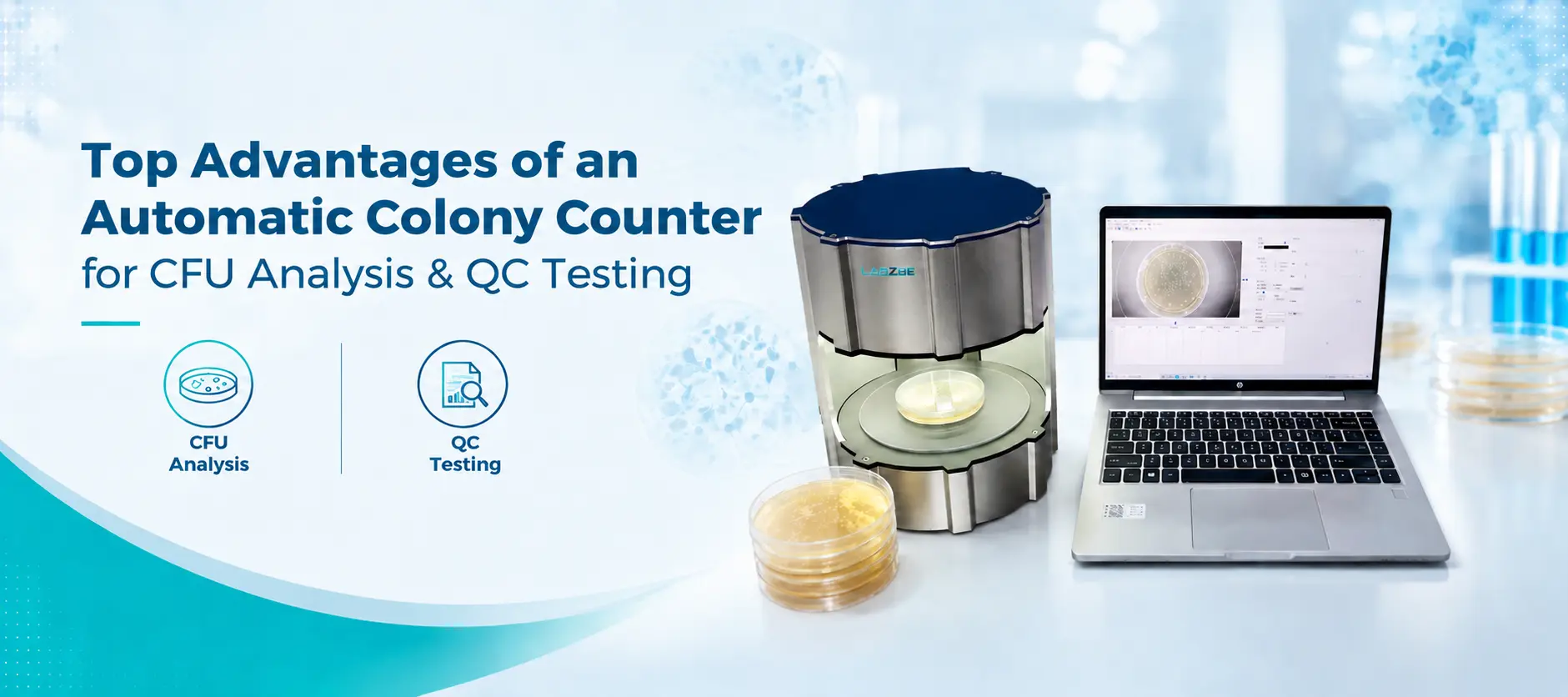
CFU analysis lives or dies on whether the count a technician records today would match the count a different technician gets from the same plate. An automatic colony counter changes that equation by replacing visual estimation with a fixed imaging process applied the same way, plate after plate. This article looks at four specific advantages that matter for QC testing, using the Automatic Colony Counter BZAT-501 as a working example.
Cuts per-plate processing time, which matters when a QC schedule has many plates due the same day.
Applies the same detection settings plate after plate, removing operator-to-operator drift from CFU figures.
Exports results in formats that fit into an audit trail rather than a handwritten logbook.
Handles more than one dish size, which matters when different protocols call for different plate formats.
The BZAT-501 completes a count in under one second per plate. On a day when a QC lab is processing many plates against a batch release deadline, that difference compounds: a technician spends the saved time on sample preparation, documentation, or the next batch rather than repeating visual tallies plate by plate. This is one of the more direct arguments for an auto colony counter over a manual process in high-volume testing environments, and one of the more common automatic colony counter machine reasons QC labs give for switching away from manual tallying.
A manual colony counter depends on a person's visual judgment call on where one colony ends and another begins, and that judgment can shift slightly across a shift or between different technicians reading the same plate. In CFU analysis feeding a pass/fail decision, that variability is not a minor detail — it can shift a batch from within specification to out of specification depending on who did the count. The BZAT-501's imaging system applies the same detection threshold, down to a smallest detectable colony size of 0.1mm, and dual 360° LED illumination to each plate it processes, which removes that source of variation from the count itself. This is the core argument behind automatic colony counter uses in any setting where a count has to hold up under review.
Automatic colony counter diagram: consistent colony boundary detection applied across replicate plates
Add a labelled diagram comparing detection boundaries across two replicate platesBuyers evaluating this kind of consistency across brands can compare imaging specifications directly on the Labzee colony counter category page, which is a more useful comparison point than brand name alone — some searches for this category reference a specific competing line by name, such as colony counter interscience or automatic colony counter interscience, but detection threshold and illumination method are what actually determine count consistency, whichever brand is being considered.
A count that only exists as a handwritten number in a logbook is harder to trace back to a specific plate, date, and operator than a digital record tied to an image of the plate itself. The BZAT-501 supports USB export and generates reports in Excel and PDF formats, along with historical result storage, which gives a QC team a record that can be pulled up again during an internal review rather than reconstructed from memory or a paper log.
QC protocols do not all use the same dish size: the BZAT-501 covers standard 55mm and 90mm dishes as well as larger dishes up to 120mm, and is offered with 5M, 8M, or 10M camera resolution options depending on how fine the required detection needs to be. A lab occasionally described as needing an automatic color colony counter is usually referring to this kind of imaging setup, where the camera renders the plate in full color for the operator to review alongside the automated count rather than relying on a monochrome readout.

| Specification | Value |
|---|---|
| Counting speed | Under 1 second per plate |
| Dish compatibility | 55mm & 90mm standard, up to 120mm maximum |
| Camera resolution | 8.29 megapixels (5M/8M/10M options) |
| Smallest detectable colony | 0.1mm |
| Lighting | Dual 360° LED, adjustable brightness |
| Dimensions (W×D×H) | 290 × 260 × 380 mm |
| Weight | 3 kg |
| Power supply | AC 100V–240V, 50Hz |
| Housing material | ABS plastic |
| Data export | USB export; Excel and PDF report formats |
The Labzee colony counter category page groups plate-counting instruments for microbiology, pharmaceutical QC, and food safety testing, where buyers typically compare counting speed, dish compatibility, and export options across models. An automatic colony counter in microbiology QC settings is usually chosen alongside other shared lab equipment, and colony counters sit within Labzee's wider catalog of laboratory instruments — spanning glassware washers, temperature and humidity chambers, and autoclave sterilizers all viewable from the Labzee home page for labs equipping more than one department.




