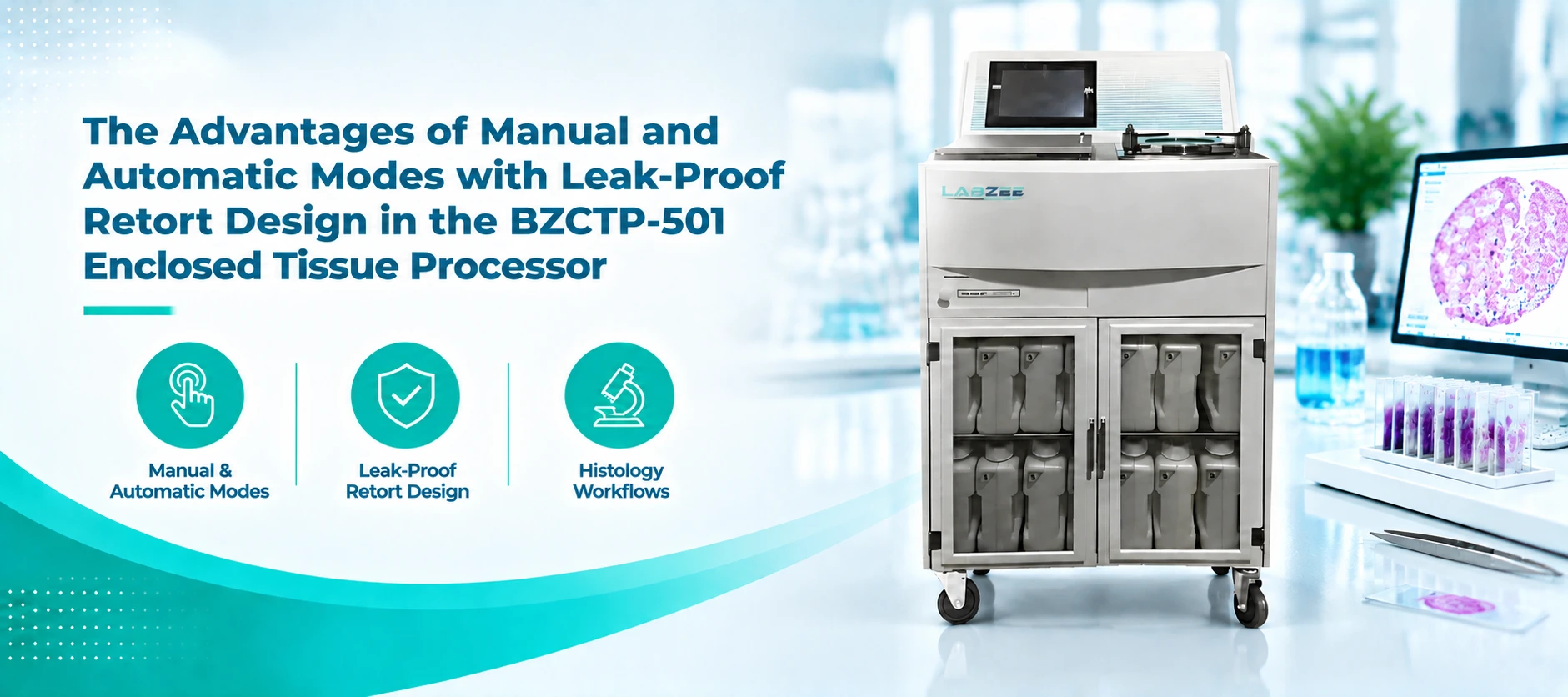
A tissue processor spends most of its working life running unattended, moving cassettes through fixation, dehydration, clearing, and wax infiltration overnight. But not all cycles in a laboratory follow a fixed schedule, and not all reagent chambers stay sealed under repeated use. The Enclosed Tissue Processor BZCTP-501 addresses both points directly: it offers manual and automatic operating modes for different situations, and it holds its reagents inside a retort built to resist leaks across long duty cycles.
Most laboratory work with an automated tissue processor happens in automatic mode: a saved program runs baskets of cassettes through each reagent station for a set duration, at a set temperature, without staff intervening between steps. This is how an automatic tissue processing machine handles routine overnight batches, and it is the mode a tissue processing lab relies on for predictable turnaround across a mixed daily caseload.
Manual mode exists for situations that do not fit a program. A technician may need to hold a specimen in a single reagent station longer than usual, repeat a step after inspecting a difficult sample, or move cassettes out of sequence while troubleshooting a run. On a histology tissue processor built with both modes, this control sits alongside the automatic program rather than replacing it, so staff are not forced to interrupt a whole cycle to adjust one station.
A simplified enclosed tissue processor diagram showing how the two modes branch from the same reagent sequence
The retort is the sealed chamber where cassettes sit through each reagent stage, and it is under repeated pressure and vacuum cycling during infiltration. A retort that seals poorly lets vapours and reagent escape between stations, which is both a fume exposure issue and a source of drift in the timing a program is supposed to control. This is one of the quieter parts of enclosed tissue processor design: capacity and program count are easy to compare on a spec sheet, but a chamber that holds its seal across thousands of cycles is not.
A leak-proof retort keeps reagent concentration where the program expects it to be, station by station, which is part of what makes an enclosed tissue processor in histopathology suited to unattended overnight running. It also reduces how often gaskets and seals need replacing, which matters for laboratories running the unit daily rather than occasionally. Staff working near the instrument benefit as well, since a sealed chamber is what keeps xylene and formalin vapours contained rather than drawn into the room air.

The value of having two modes on one piece of tissue processing equipment shows up differently depending on the setting.
A busy histopathology department leans on automatic mode almost exclusively, letting a saved program carry a full caseload through the reagent sequence while the laboratory is unattended.
Study cohorts sometimes need a station held or repeated mid-run, which is where manual control on a tissue processor device lets staff adjust one step without disturbing the rest of the sequence.
Facilities handling both routine biopsies and unusual specimens use automatic mode for the bulk of the caseload and switch to manual control when a sample needs closer attention.
Manual mode also gives staff a way to move the retort through individual stations while checking reagent levels or verifying a program change before the next overnight run.
The BZCTP-501 is one model within the broader tissue processor category, which spans open carousel units and enclosed, reagent-managed systems built around a sealed retort. Buyers comparing tissue processor machine options in this category typically weigh cassette capacity, the number of reagent stations, whether pressure and vacuum assist infiltration, and how far the chamber design goes toward containing fumes and resisting leaks over time. Availability of both manual and automatic modes is a further point worth checking, since not all enclosed units offer step-level control alongside their saved programs.
Laboratories weighing these points can review the full range on the tissue processor category page, which groups models by capacity and reagent handling. That line sits within a wider catalogue of laboratory equipment, and the Labzee home page sets out the other instrument categories the company covers, which is a useful starting point when a processor purchase is being planned alongside the rest of a laboratory bench.
A few recurring gaps show up once a processor is already in daily use, well after the purchase decision has been made.
Departments that only compare program counts and cassette capacity sometimes overlook whether manual control is available at all. Without it, an unusual specimen or a mid-run adjustment has no clean way to be handled short of stopping the whole cycle.
Seal condition rarely appears on a comparison sheet, yet it governs both fume containment and how evenly reagents reach each cassette. Asking how the retort is sealed, and how that seal holds up over repeated pressure and vacuum cycles, belongs earlier in the buying conversation than it usually gets placed.
A capacity that suits a typical batch falls short once caseloads spike. Matching capacity, and the reagent stations that support it, to peak demand avoids a backlog on the laboratory's busiest days, and comparing cassette capacities across the tissue processor range before ordering helps confirm the right fit.
Some laboratories assume switching between manual and automatic mid-cycle is seamless without checking how the instrument actually manages that handover, which can affect timing on the stations already underway.
Processors built around a single fixed program differ from those offering both modes in a few concrete ways, set out below.
| Aspect | Automatic-only processor | Manual and automatic (BZCTP-501) |
|---|---|---|
| Routine overnight runs | Handled by saved program | Handled by saved program |
| Mid-run adjustment | Requires stopping the cycle | Individual station control available |
| Unusual or difficult specimens | Limited to program parameters | Station can be held or repeated as needed |
| Troubleshooting a run | Full cycle interruption | Manual stepping without disturbing the rest |
| Retort sealing | Varies by model | Leak-proof retort across both modes |
For most laboratory schedules, automatic mode carries the bulk of the caseload while manual mode remains available for the exceptions, which is the balance this class of automatic tissue processor is built around.




