Introduction
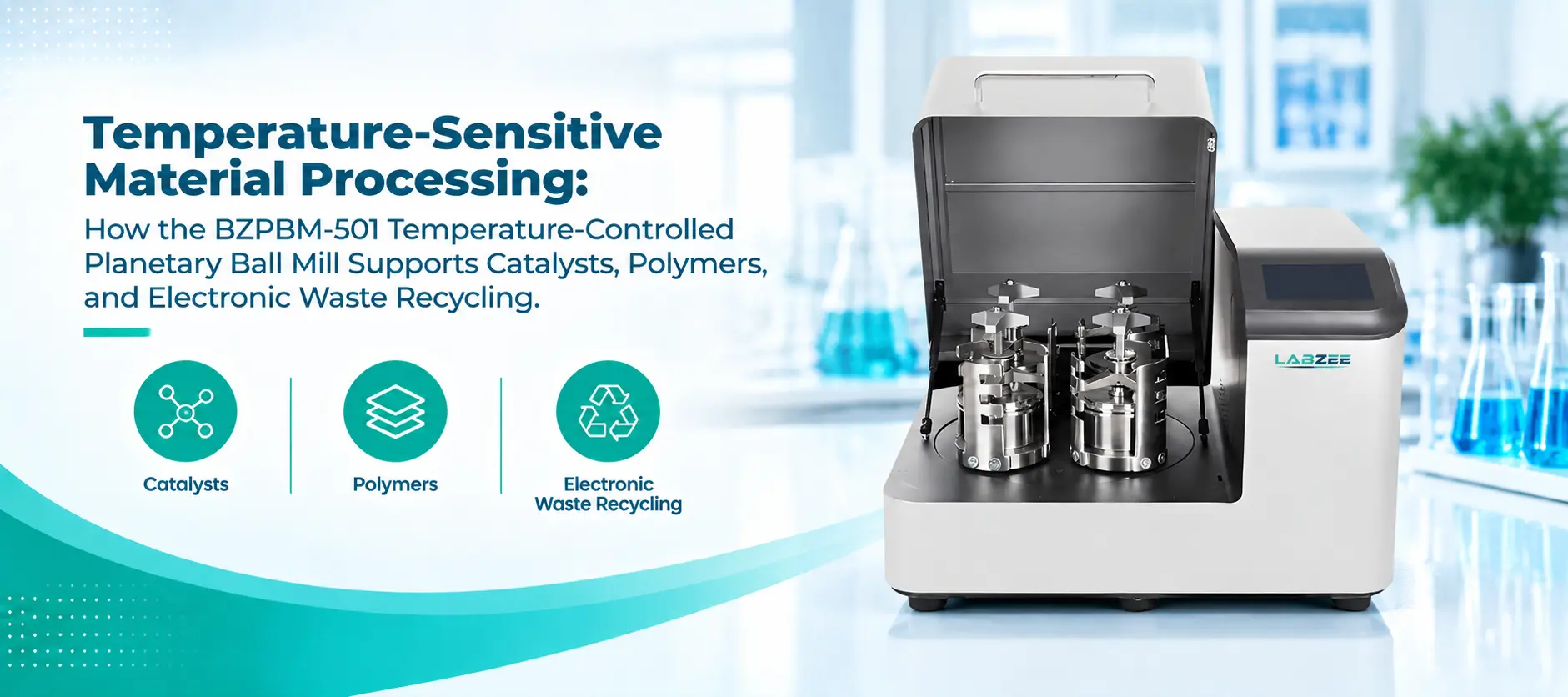
Grinding generates heat. In a fast, high-energy mill, the friction and impact that reduce a sample also warm it, and for many materials, that warming is the problem rather than a side effect. Catalysts lose active area, polymers soften and smear, and recovered metals oxidise. The Temperature-Controlled Planetary Ball Mill BZPBM-501 is designed around that issue, pairing planetary grinding with active thermal management so a sample reaches the target particle size without exceeding the temperature it can tolerate.
A planetary ball mill grinds by motion rather than by a single crushing stroke. Jars sit on a rotating sun wheel and spin on their own axes in the opposite direction, so the grinding balls inside are thrown across each jar and then dragged around its wall. The result is a mix of high-speed impact and shearing friction that fractures particles far faster than a simple tumbling mill, which is why a high-energy planetary ball mill can reach fine and even sub-micron sizes. A planetary ball milling machine of this type is a laboratory staple for exactly that reason.
The temperature-controlled planetary ball mill working principle adds a thermal layer to that mechanical action. A jacket, forced air, or programmed rest intervals draw heat away from the jars, and a sensor feeds a controller that adjusts milling and cooling to hold a set band. Understanding the temperature-controlled planetary ball mill design in this way, grinding and cooling managed together, explains why the same run that would overheat in an ordinary unit stays within range here.
Planetary grinding with a closed temperature loop running alongside
For heat-sensitive materials, the temperature at the point of impact decides whether a sample survives the process intact. Without control, a long grind can push a jar well above ambient, and three failure modes follow. Polymers cross their glass transition and stick to media and jar walls instead of fracturing. Catalyst supports sinter or lose surface area, dulling the property the material was made for. Metal fractions from circuit boards oxidise, which complicates later separation and recovery.
Holding a defined band avoids each of these. It also protects results that depend on structure, such as phase-sensitive compounds and mechanochemical reactions where temperature steers the outcome. That is a large part of what a temperature-controlled planetary ball mill used for heat-sensitive work delivers: a grind whose chemistry and morphology are set by the operator, not by uncontrolled heating.

Three fields in particular gain from keeping heat under control while grinding, each for a different reason.
Milling adjusts particle size and can drive mechanochemical synthesis, but active sites are heat-fragile. A controlled band preserves surface area and dispersion, so the finished powder keeps the activity the formulation depends on.
Polymers soften near their transition temperature and clog media. Cooling keeps them brittle enough to fracture cleanly, which supports fine powders for coatings, additive feedstock, and filler dispersion.
Shredded boards mill into a fraction where metals can be separated from resin and glass. Limiting heat curbs oxidation and keeps volatile components in check, improving the yield of recoverable material.
A laboratory planetary ball mill with temperature logging lets researchers repeat a grind under the same thermal profile, which matters when heat is a variable in the study itself.
The BZPBM-501 belongs to the wider group of ball mill machines, a category that ranges from simple mixer and tumbling mills through to the high-energy planetary ball mill, with and without thermal control. When comparing a planetary ball mill machine, buyers usually weigh the number and volume of jars, the range of grinding media and jar materials, the speed and energy the drive delivers, and, for heat-sensitive work, whether and how temperature is managed. The temperature-controlled planetary ball mill sizes on offer, from compact benchtop units to larger multi-jar frames, also shape which fits a given throughput.
To compare the options, you can browse the full range on the ball mill machine category page, which groups models by type and capacity. The mill is also one part of a broader instrument catalogue, and the Labzee laboratory equipment homepage sets out the other disciplines the company covers, which helps a buyer plan a milling purchase alongside wider lab needs.
Selecting a mill for heat-sensitive work brings traps beyond raw grinding power.
A faster mill grinds quicker but also heats faster, so raw speed on a heat-fragile material can defeat the purpose. Matching cooling capacity to the intended grind matters as much as the drive.
The temperature-controlled planetary ball mill balls and jar material affect contamination, wear, and how heat moves through the charge. A hard sample and a soft media pairing can introduce impurities that spoil a result.
Choosing capacity for one sample ignores future throughput. Comparing the models grouped under the Labzee ball mill machine range against expected volume avoids a unit that is soon outgrown.
For sensitive materials, the thermal history is part of the result. A mill that controls but does not log temperature leaves a gap when a process needs to be validated or repeated.
No single configuration suits standard grinding and heat-sensitive work alike. The table sets out where a temperature-managed planetary mill earns its place against a conventional unit.
| Consideration | Standard planetary mill | Temperature-controlled planetary mill |
|---|---|---|
| Suited material | Heat-tolerant minerals, ceramics | Catalysts, polymers, e-waste, phase-sensitive samples |
| Heat handling | Rest pauses only | Active cooling to a set band |
| Run length | Limited by heat build-up | Extended runs within range |
| Process record | Speed and time | Speed, time, and thermal profile |
| Typical use | Routine size reduction | Method-sensitive and recovery work |




