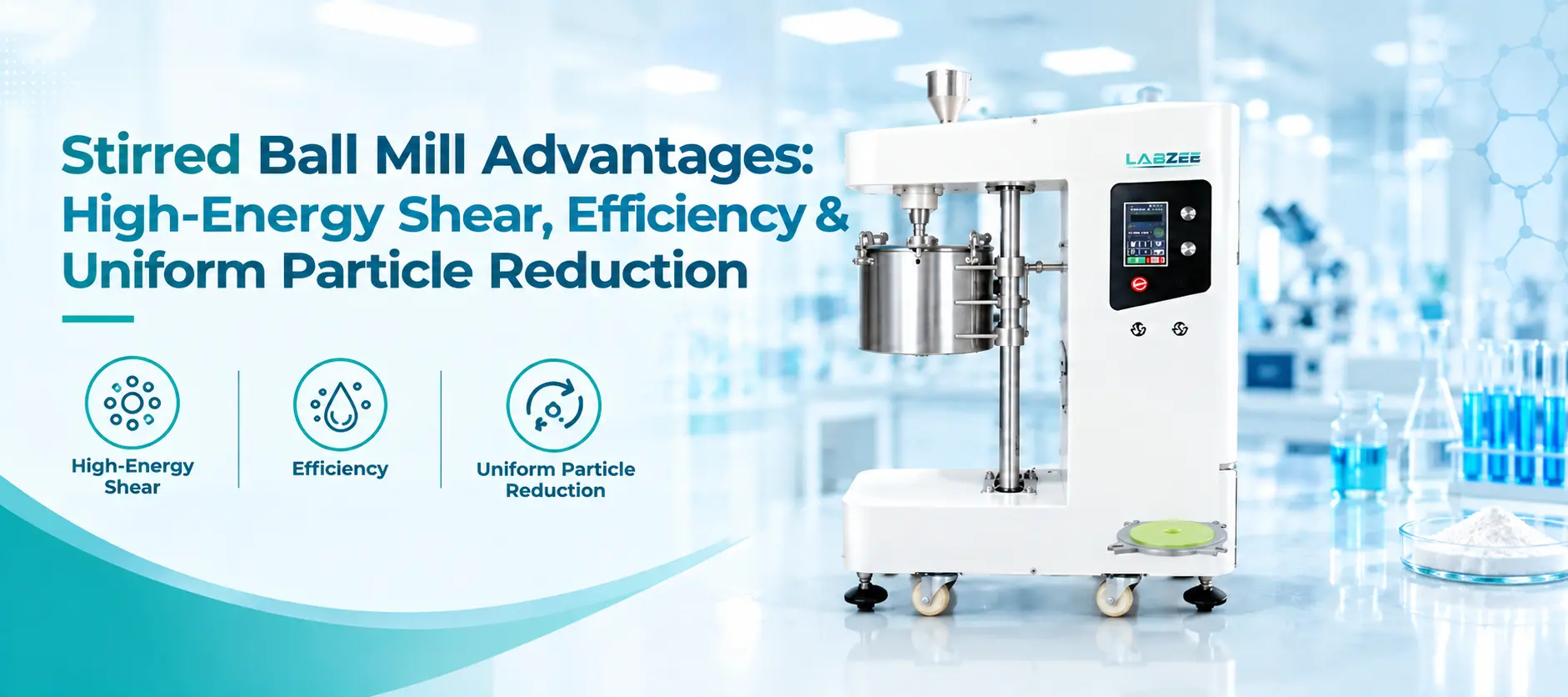
Not all fine-grinding equipment reaches sub-micron particle sizes the same way, and the mechanism behind a stirred ball mill is a large part of why it holds an edge for fine dispersion and grinding work. Rather than relying on tumbling impacts, it channels continuous shear energy directly into the material. This article looks at three specific advantages that come from that mechanism high-energy shear, grinding efficiency, and particle uniformity using the Stirred Ball Mill BZSJM-501 as a working reference.
Lab ball mill designs vary widely in how they apply grinding force. Tumbling and vibrating formats deliver energy in bursts, as media falls or oscillates against the material. An agitated ball mill instead maintains a continuous high-shear zone: a motor-driven agitator keeps stirred balls in constant contact with the material and with each other across the full batch, rather than relying on gravity-driven collisions. On the BZSJM-501, that agitator runs across a 0–1000 rpm range, and this stirred ball mill design trades peak impact force for sustained, controllable shear that can be dialed to the material being processed.
Stirred ball mill diagram: continuous shear zone between the agitator, grinding media, and chamber wall
Add a labelled diagram showing shear zone geometry and media motionEfficiency in a stirred media mill is less about raw speed and more about how consistently energy reaches the material. Because stirred mills apply shear continuously rather than intermittently, less agitation time is wasted between effective contacts, which is why a laboratory stirred ball mill can often reach a target particle size using less total processing time than a tumbling design working the same batch. On the BZSJM-501, a 1500W drive paired with a water cooling cycle keeps that continuous agitation from overheating the batch, which matters because uncontrolled heat buildup is usually what limits how long a stirred mill's speed can be pushed before output quality suffers. Readers weighing efficiency against other lab ball mill formats can compare drive power and cooling specifications on the Labzee ball mill machine category page.

The full batch passes through the same shear zone repeatedly instead of receiving occasional impacts, narrowing the spread between the largest and smallest resulting particles.
A 0–1000 rpm range lets operators match shear intensity to material hardness, which helps avoid both under-processed clumps and over-milled fines in the same run.
A stable, cooled chamber keeps viscosity and reaction behavior consistent through a full batch, rather than shifting as the run progresses and skewing the final particle distribution.
| Specification | Value |
|---|---|
| Grinding tank volume | 2 L |
| Charging capacity | 660 ml |
| Stirring speed range | 0–1000 rpm |
| Power consumption | 1500 W |
| Cooling method | Water cooling cycle |
| Dimensions (W×D×H) | 78 × 55 × 132 cm |
| Net weight | 130 kg |
| Gross weight | 183 kg |
The Labzee ball mill machine category page groups the stirred design covered here alongside planetary, roller, vibrating, and three-roll mills, so buyers can compare grinding mechanism, capacity, and speed range side by side before choosing a laboratory mill. For Labzee's full range of lab equipment outside milling, the Labzee home page is the starting point.