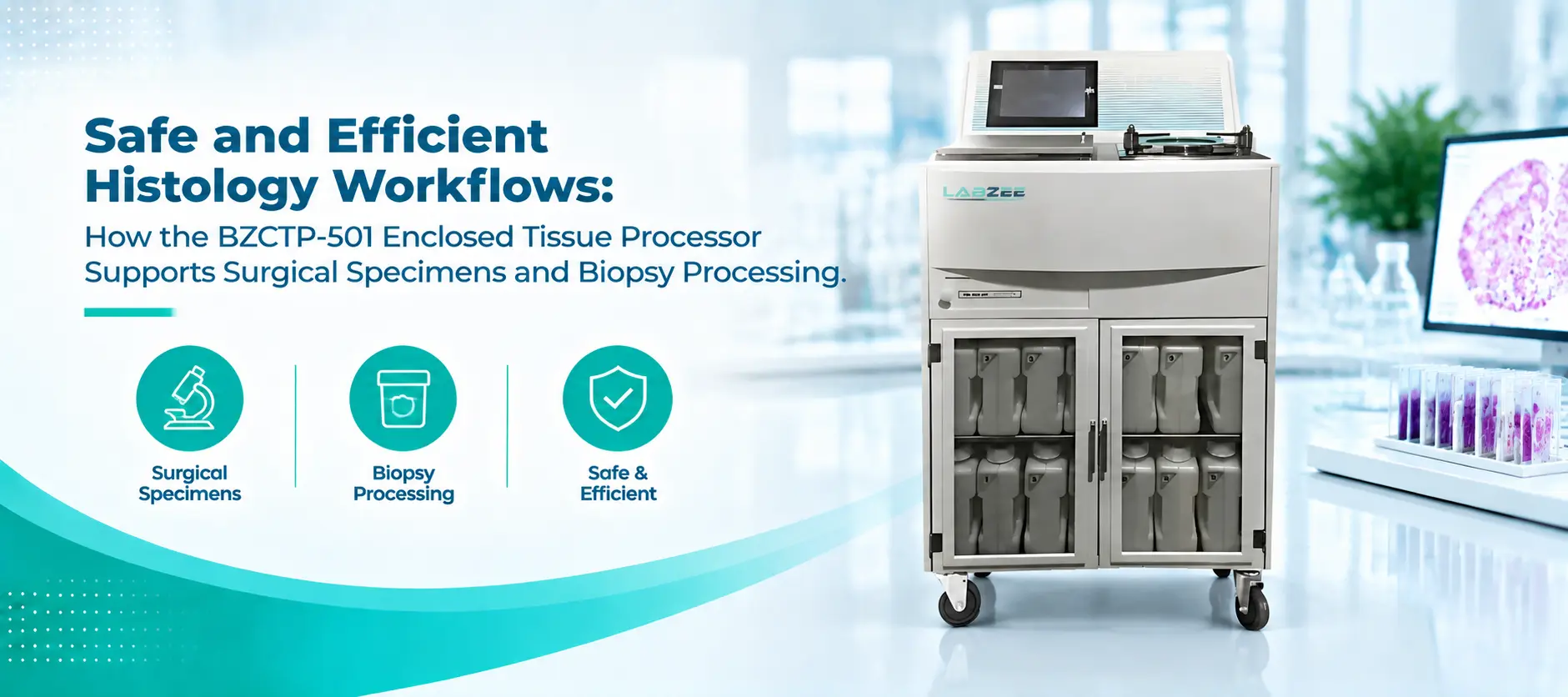
Between a specimen leaving theatre and a slide reaching the pathologist sits a long, unglamorous process: tissue has to be fixed, dewatered, cleared, and filled with wax before it can be sectioned. Done unevenly, it undoes the whole case. The Enclosed Tissue Processor BZCTP-501 automates that sequence in a sealed system, so surgical specimens and biopsies move through the same controlled steps while the reagent vapours stay contained.
Tissue processing runs a fixed order of reagent baths that prepare a specimen for embedding. After fixation, the tissue passes through graded alcohols that draw out water, then a clearing agent such as xylene that makes the tissue receptive to wax, and finally molten paraffin that infiltrates the structure so it can be cut into thin sections. An automated tissue processor moves baskets of cassettes through these steps on a timed program, holding each bath for the set duration and temperature.
Two features decide the quality of the result. Agitation and, in many units, pressure and vacuum cycles drive reagents into dense or fatty tissue that would otherwise process unevenly, and precise timing keeps delicate biopsies from over-hardening while larger specimens finish. Because an automatic tissue processing machine repeats the same program overnight, a laboratory wakes to blocks ready for embedding rather than a queue of manual transfers. The enclosed tissue processor diagram, from cassette to infiltrated block, shows how each reagent stage builds on the last.
The reagent sequence that prepares tissue for embedding and sectioning
The reagents behind good sections are also the hazard: xylene and formalin give off vapours that laboratory staff should not breathe over a shift. An enclosed design keeps the reagent baths and transfers inside a sealed chamber, drawing fumes through a filter rather than into the room. That containment is the difference between a processing area that needs heavy ventilation and one where staff work comfortably beside the unit.
Containment also protects the run itself. A sealed chamber holds reagent condition and temperature steady, and reduces evaporation that would otherwise shift concentrations between cycles. Reflecting the enclosed tissue processor design, the same barrier that guards the operator keeps the chemistry consistent, so results do not drift as reagents age. For a busy tissue processing lab, that combination of safety and stability is what makes overnight, unattended running practical.

The same instrument serves different specimen types and settings, each asking something slightly different of the program.
Larger resections need longer infiltration to process fully to the centre. A histology tissue processor with pressure and vacuum cycles drives reagents through dense tissue so the block cuts cleanly.
Endoscopic and needle biopsies are easily over-processed. A shorter, gentler program on the same tissue processor machine protects fine detail while still fixing and infiltrating the sample.
Routine diagnostic workloads depend on overnight batches that are ready by morning. An automatic tissue processor keeps turnaround predictable across a mixed daily caseload.
Study cohorts and training sets need consistent processing so sections compare fairly. A tissue processor device with saved programs repeats conditions across many samples.
The BZCTP-501 belongs to the wider group of tissue processors, a category split mainly between older uncovered carousel units and modern enclosed, reagent-managed systems. When comparing tissue processing equipment, buyers usually weigh cassette capacity against footprint, the number of reagent stations, whether pressure and vacuum assist infiltration, how fumes are contained and filtered, and how reagents are rotated or exchanged. The role of the enclosed tissue processor in histopathology has grown as laboratories move toward sealed handling of hazardous reagents, which shapes much of the comparison.
To see how the range fits together, you can browse the full lineup on the tissue processor category page, which groups models by capacity and features. This line is one part of a broader catalogue of laboratory equipment, and the Labzee laboratory equipment homepage sets out the other disciplines the company covers, which helps a laboratory plan a processor purchase alongside its wider bench.
Selecting a processor goes wrong most often in the gap between a headline capacity and how a real specimen mix behaves.
A capacity that fits a typical night falls short on a heavy day. Matching cassette capacity to peak workload, not the average, avoids a backlog when caseloads spike, which is a first question when specifying tissue processor equipment for a department.
Processing quality falls as reagents tire. A unit that rotates and monitors reagents holds results steady, while one left to manual tracking drifts, so how the machine manages its baths matters as much as its speed.
A program tuned for large specimens can ruin small biopsies and the reverse. Confirming the processor handles the full span of the caseload, and comparing options across the Labzee tissue processor range, prevents a mismatch.
Ventilation and filtration are part of the purchase, not an afterthought. Understanding the enclosed tissue processor uses in a shared laboratory means planning how vapours are contained and filters maintained from the start.
No single design suits all laboratories, but the shift from open carousel units to enclosed systems changes several things at once. The table sets out where each stands.
| Aspect | Open carousel processor | Enclosed reagent-managed processor |
|---|---|---|
| Fume exposure | Open baths, higher exposure | Sealed chamber, filtered extraction |
| Reagent condition | Evaporation between cycles | Contained, more stable |
| Infiltration | Immersion and agitation | Pressure- and vacuum-assisted |
| Unattended running | Limited by ventilation | Suited to overnight batches |
| Reagent handling | Manual tracking | Managed rotation and exchange |