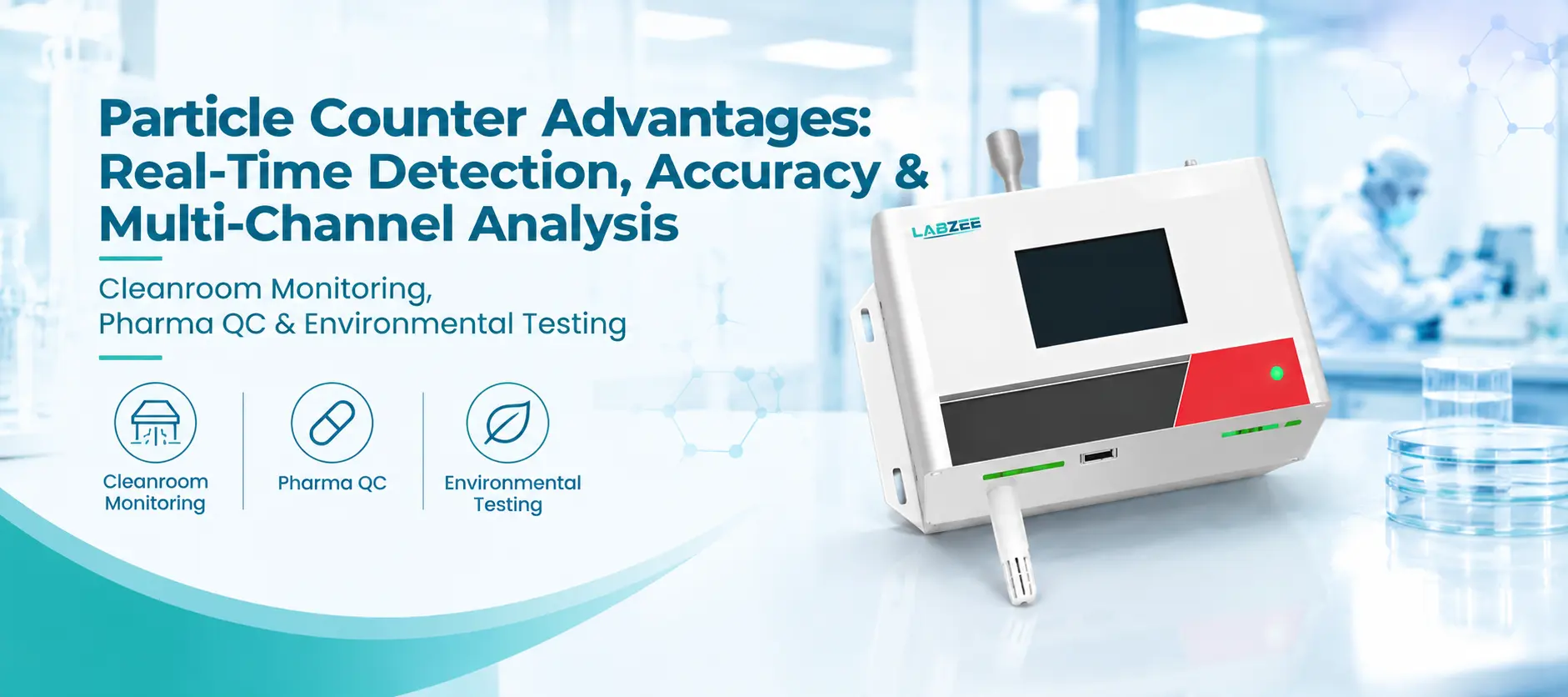
A count is only as useful as how quickly it appears, how closely it matches what's actually in the air, and how much size detail it captures in one pass. A particle counter instrument earns its place on a cleanroom wall by delivering on all three at once, not just one. This article looks at what each of these three factors changes in practice, using the Airborne Particle Counter BZAP-501 as a working example.
Surfaces a threshold breach as it happens rather than after a scheduled check finally catches it.
Determines whether a reading reflects what's actually in the air, not just what the sensor happened to catch.
Classifies particles by size in a single pass instead of running separate checks for each size range.
The BZAP-501 powers on and is ready to sample in 8 seconds or less, then refreshes its reading on a 1-second cycle during operation. That refresh rate is what makes visual and audio threshold alarms meaningful: a contamination spike gets flagged while it's happening, not discovered on the next scheduled walkthrough. For a particle counter clean room installation running continuously, this changes monitoring from a periodic spot check into an ongoing record of conditions.
Particle counter diagram: continuous sampling feed against a threshold alarm trigger point
Add a labelled diagram showing the sampling timeline and alarm trigger pointTwo details drive how much a reading can be trusted: counting efficiency at the smallest channel, and how the sample itself is drawn in. The BZAP-501 is rated at 50% counting efficiency at its 0.3µm channel, and pulls its sample through an isokinetic probe designed to match the surrounding airflow speed rather than pulling air in faster or slower, which would otherwise skew which particle sizes actually reach the sensor. Detection range extends up to 1,000,000 particles per 28.3L sample, wide enough to stay useful whether a space is meeting classification or badly out of it.
Facilities weighing accuracy specifications against other models can compare counting efficiency and detection range figures on the Labzee particle counter category page, rather than judging accuracy from channel count alone.
ISO 14644-1 cleanroom classification depends on particle counts across more than one size threshold at once, not a single reading. The BZAP-501 captures five channels simultaneously above 0.3µm, 0.5µm, 1.0µm, 5.0µm, and 10µm in the same sampling pass, so a classification result reflects one consistent moment in time across all five size bands rather than stitching together readings taken at different times. This particle counter design choice is part of what makes a single unit sufficient for a full classification check rather than needing multiple instruments run in sequence.
A particle counter in pharma industry cleanrooms benefits from real-time alarms feeding directly into batch documentation, while hospital and healthcare facility cleanrooms rely on the same continuous record for compliance reviews. Semiconductor and precision manufacturing environments lean more heavily on accuracy at the smallest channel, where sub-micron contamination has outsized consequences, and a particle counter lab running comparative studies benefits most from multi-channel data captured in a single pass rather than sequential single-channel readings.

| Specification | Value |
|---|---|
| Sensing method | Optical light-scattering |
| Flow rate | 28.3 L/min |
| Particle size channels | >0.3, >0.5, >1.0, >5.0, >10µm |
| Counting efficiency | 50% at 0.3µm |
| Detection range | 0–1,000,000 particles/28.3L |
| Power-on time | ≤8 seconds |
| Data refresh rate | 1 second |
| Display | 3.5-inch color screen |
| Operating range | 0–45°C, 0–95% RH non-condensing |
| Power supply | DC 24V ±15%, ≤3A |
| Communication | RS485 interface |
| Dimensions (W×D×H) | 202 × 85 × 124 mm |
| Weight | 2 kg |
Labzee's particle counter lineup includes more than one particle counter design: airborne models like the BZAP-501, a benchtop liquid particle counter, laser airborne counters, and a dedicated portable particle counter for field use. Rather than assuming one unit covers all sampling needs, buyers typically match sample type and use pattern first, then compare detection specifications within that group on the Labzee particle counter category page. Labzee's broader catalog of laboratory instruments is available from the Labzee home page for labs sourcing equipment beyond contamination monitoring.




