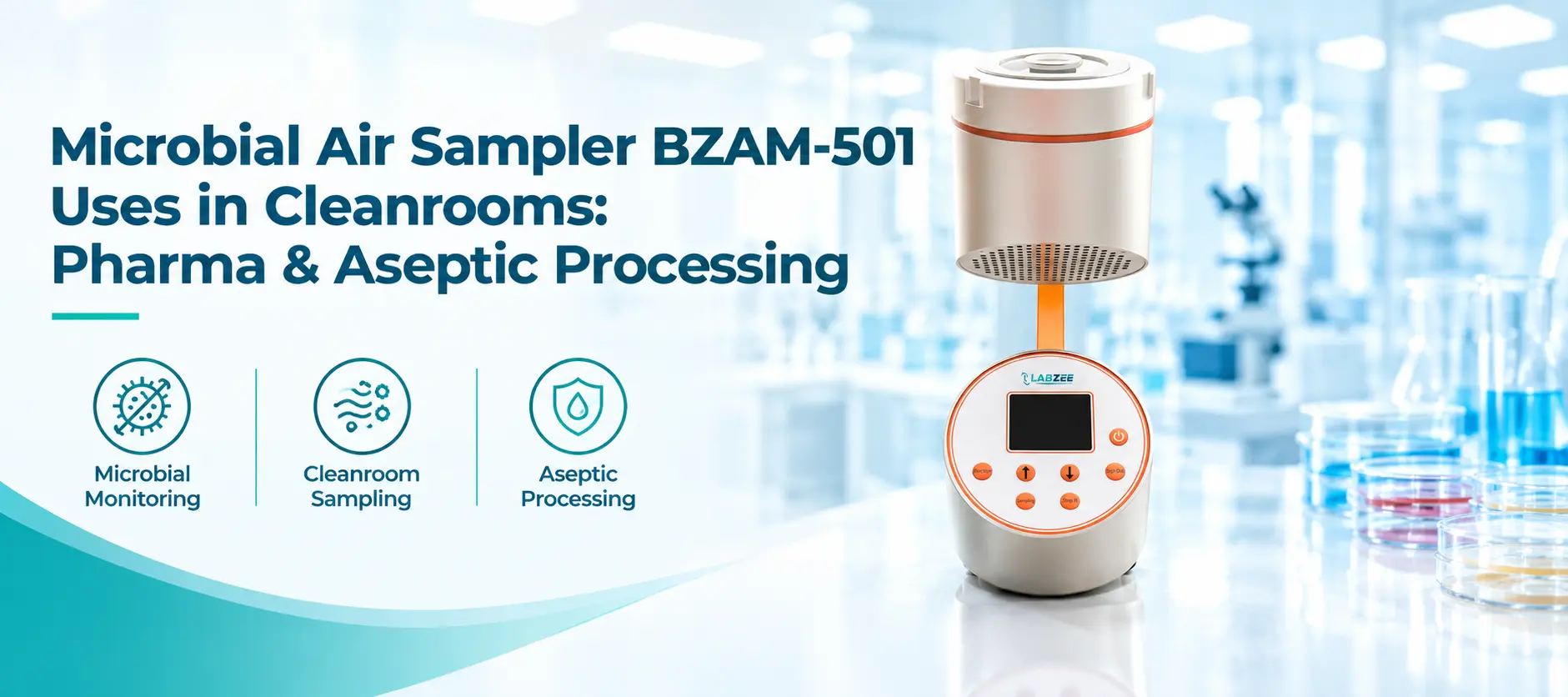
Counting particles in the air tells you how clean a room looks on paper; culturing what's actually alive in that air is a different measurement entirely, and it's the one that matters for aseptic processing. A microbial air sampler is built for that second job, pulling a controlled volume of air across a culture plate so viable organisms can be counted after incubation rather than assumed. This article covers how that process works and where it fits into cleanroom workflows, using the Microbial Air Sampler BZAM-501 as a working example.
The BZAM-501 uses an Anderson impact-level sampling principle, drawing air through a porous suction head at roughly 10.8 m/s so that airborne particles strike a standard petri dish at a controlled, even distribution rather than clumping in one spot. Flow rate holds at 100 L/min, and sampling volume is adjustable from 1 to 6,000 L depending on how long a monitoring run needs to last. That combination is what separates this microbial air sampler design from passive settle-plate methods, which simply leave a plate open and rely on gravity rather than active suction to deposit organisms.
Microbial air sampler drawing: suction head, impaction airflow path, and petri dish plate position
Add a labelled diagram showing airflow entry, impaction point, and plate seatingAir sampling equipment covers a wide range of purposes, and not all of it targets living organisms. General-purpose air sampling devices built to count particulates or track chemical exposure record numbers without culturing anything, while a microbiological air sampler specifically captures organisms onto a growth medium so a lab can identify and count colonies afterward. Readers researching this equipment under slightly different terminology air microbial sampler, microbial air sampling equipment, or similar phrasing are usually looking at the same product category from different manufacturers, so comparing flow rate, sampling volume range, and plate compatibility side by side is a more useful starting point than the product name alone. The Labzee air sampler category page groups these formats together for that kind of comparison.

As a portable microbial air sampler, the unit's 5kg net weight and 13×13×30cm footprint let it move between cleanroom zones during a single validation round rather than requiring a fixed installation point.
| Specification | Value |
|---|---|
| Sampling flow rate | 100 L/min ±5% |
| Sampling principle | Anderson impact level, 10.8 m/s |
| Sampling volume range | 1–6,000 L (adjustable) |
| Dust capacity | 100,000,000 particles/m³ @0.5µm or 0.2mg/m³ |
| Plate compatibility | Standard petri dishes |
| Display/control | Button screen interface |
| Operating temperature | 10–35°C |
| Operating humidity | 10–90% RH |
| Atmospheric pressure range | 80–110 kPa |
| Battery life | Over 8 hours |
| Power | 16.8V |
| Dimensions | 13 × 13 × 30 cm |
| Net weight | 5 kg |
| Gross weight | 7 kg |
The Labzee air sampler category page lists two distinct formats: biological air samplers built for pharmaceutical, hospital, and food-processing settings, and microbial air sampling equipment like the BZAM-501, aimed at cleanroom compliance and environmental monitoring specifically. Buyers typically compare sampling principle, flow rate, and plate or media compatibility before choosing between them. Labzee's wider catalog of laboratory instruments beyond air sampling is available from the Labzee home page.




