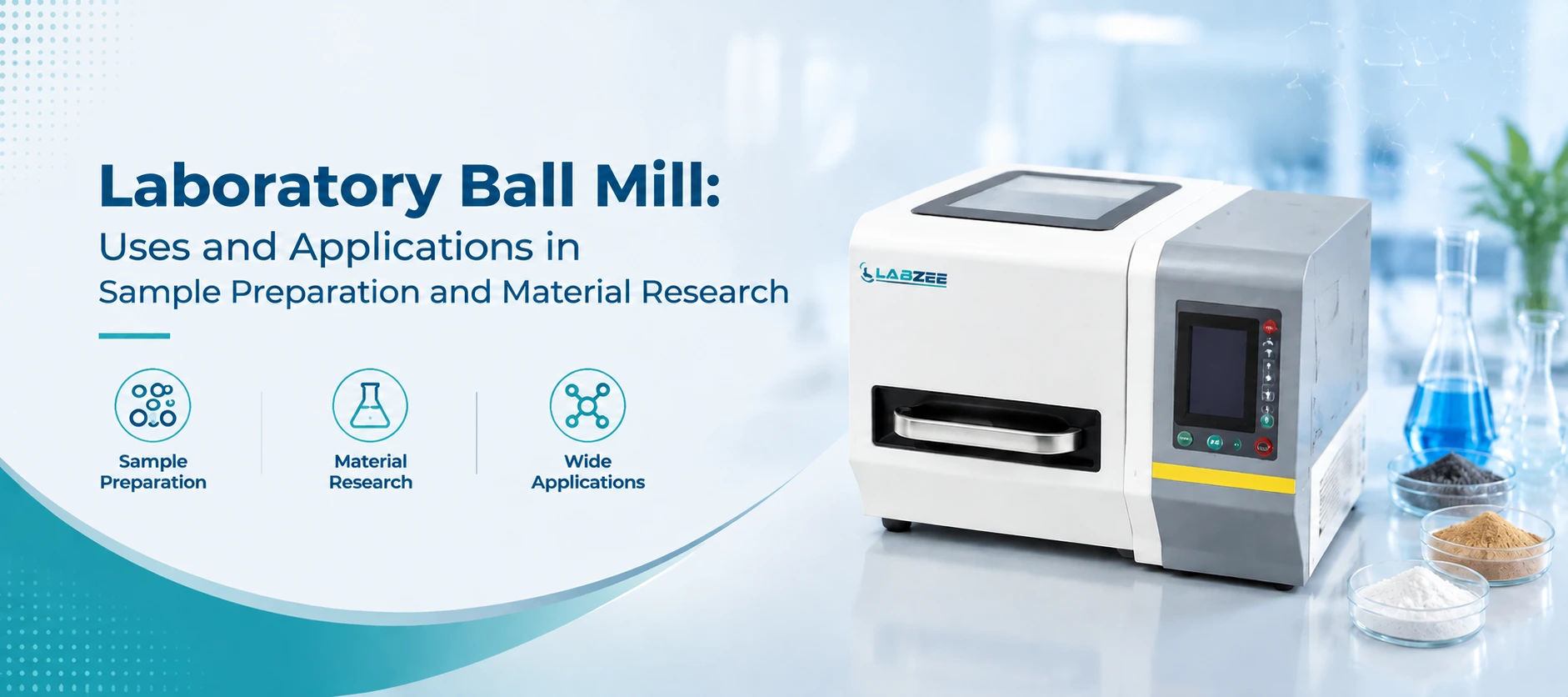
A laboratory ball mill reduces coarse feed to a fine, even powder ready for analysis, formulation or further processing, which is why it anchors so many sample preparation and material research workflows. This guide walks through how a planetary mill works, where it earns its place, and what to weigh before choosing one, with the Advanced Nano Planetary Ball Mill BZABM-501 as a reference point throughout.
The word planetary describes the motion at the heart of the design. Grinding jars ride on a rotating sun disc while each jar turns on its own axis in the opposite direction, much as planets move around a star. That counter-motion makes a planetary mill far more energetic than a simple rolling drum, so it copes with hard, brittle, fibrous and moist samples in one footprint.
A planetary ball mill for laboratory use is valued for moving from coarse feed to a fine powder within a short cycle. Materials scientists reach for a planetary ball milling machine when they need a controlled, repeatable route to a target particle size rather than an approximate crush.
Diagram: counter-rotating sun disc and grinding jars forming the planetary drive
Add a labelled schematic of the drive motion and jar pathInside each jar, the grinding balls and sample climb the wall with the rotation, then fly across the chamber as the counter-rotation reverses their path. Two forces do the work, and the speed ratio between disc and jar sets how hard they act.
Balls thrown across the jar strike the sample at speed, fracturing coarse particles on contact.
Rolling and shearing against the jar wall abrades particles toward the fine and ultrafine range.
The disc-to-jar ratio, timed pauses and direction reversal tune the action and keep runs even.
Operators run the process dry for free-flowing powders or wet with a solvent for sticky material and finer distributions. This measured energy transfer is what lets advanced nano planetary ball milling reach sizes that coarser equipment cannot touch.
Because it pairs high energy with tight control, the format turns up across a wide spread of laboratory work.
Micronising active ingredients and excipients for even blends and steady dissolution.
Mixing and reducing cathode, anode and electrolyte powders for cell research.
Producing fine, even powders for sintering, glazes and stronger colour.
Homogenising ores, rock and soil ahead of elemental or contaminant analysis.
Beyond these areas, the same platform supports mechanical alloying, catalyst preparation and the homogenising of plant or food samples, each asking for slightly different jar and media choices.
Pushing a powder into the sub-micron and nanometre range asks more of the equipment than routine grinding. A nano ball mill relies on very small grinding media, often between 0.1 and 3 mm, spun at high energy so that countless low-mass impacts chip away at the particles. A nano grinding mill usually runs wet, with a carefully chosen dispersant that keeps freshly formed nanoparticles from clumping back together.
Contamination control becomes central at this scale, so agate, zirconia or tungsten carbide jars and balls are matched to the sample to limit pickup. Temperature also matters, which is why extended cycles are broken into intervals with cooling pauses. A nano grinding machine set up this way lets research groups produce nano powders with a narrow, repeatable size distribution, and that is why a nano planetary ball mill has become a mainstay in material research.
A capable machine still under-performs when the setup does not suit the material. A few missteps recur when a team specifies a mill for a controlled process.
A jar or ball softer than the sample invites contamination and rapid wear. Match the hardness of agate, zirconia, stainless steel or tungsten carbide to what you are grinding.
Too few balls slow the process, while too many leave no room for movement. A ratio near 10:1 by mass is a common starting point, then tuned to the material.
Long high-speed runs raise jar temperature and can alter sensitive samples. Timed pauses and direction reversal keep the cycle controlled and cooler.
Filling past roughly a third of the jar volume leaves little space for the balls to travel, which flattens the grinding action and lengthens cycles.
The Advanced Nano Planetary Ball Mill BZABM-501 belongs to a wider family of grinding and mixing equipment, from bench planetary mills through mixer, vibratory and roller mills for gentler blending. When teams weigh options in this category, jar capacity and station count, media and jar materials, the span of the speed control, safety interlocks and bench footprint sit near the top of the list.
You can see how Labzee arranges its instruments across laboratory disciplines on the Labzee home catalogue, while the full set of sizes and grinding configurations is laid out on the ball mill machine category page for side-by-side review. Reading across the category first makes it easier to line up media options and working volume with the material a team plans to run.

A short comparison shows why grinding method shapes results before capacity does, whether a team keeps a basic drum unit or plans a high-energy setup from the Labzee ball mill range.
| Consideration | Simple drum / roller mill | Planetary ball mill |
|---|---|---|
| Energy input | Low, gravity-driven tumbling | High-energy impact and friction |
| Size reach | Coarse to medium powders | Down to fine and nano scale |
| Cycle time | Long runs for fine output | Short cycles to a target size |
| Sample range | Softer, free-flowing feed | Hard, brittle, fibrous and moist |
| Process control | Limited, mostly speed | Ratio, reversal and timed pauses |




