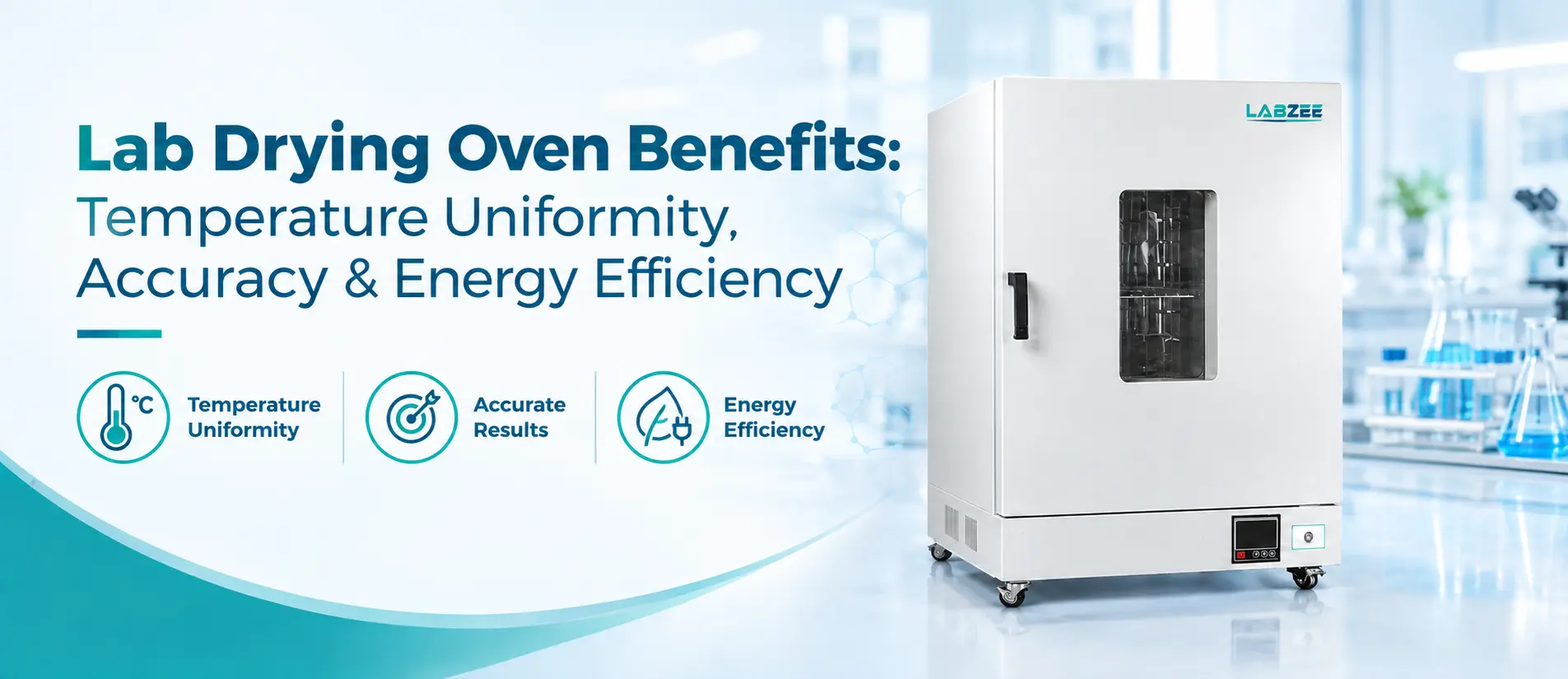
Two ovens can share the same maximum temperature on a spec sheet and still behave very differently in daily use. What separates a well-performing laboratory drying oven from one that produces inconsistent results usually comes down to three things: how evenly heat is held across the chamber, how precisely the control system tracks the set point, and how the heating design uses energy while it runs. This article looks at each in turn using the Floor Standing Air-Drying Oven BZAO-501 as a working example.
A hot air drying oven's maximum temperature tells a buyer very little about how consistent a cycle will actually be. Two points inside the same chamber can sit several degrees apart even while the display reads a single number, and that gap is what temperature uniformity describes: how much variation exists between different locations in the chamber at the same moment, as distinct from how much a single point drifts over time.
On the BZAO-501, that figure is specified at ±2.5%, separate from the ±1°C temperature fluctuation rating. A sample sitting near the chamber wall in a poorly designed air drying oven can finish a cycle under-processed relative to one nearer the fan, even when both were loaded for the same duration at the same set point.
Chamber uniformity diagram: temperature readings compared across shelf positions during a single cycle
Add a labelled diagram showing temperature readings at multiple shelf positionsA dry heat oven that simply switches its heating element on and off around a set point tends to overshoot and undershoot in a repeating pattern, which shows up as a wider fluctuation band than the number printed on the spec sheet suggests. The BZAO-501 instead runs its forced-air convection system through a PID microprocessor controller, continuously adjusting heating output rather than cycling between fully on and fully off.
That control approach is what supports a stated temperature resolution of 0.1°C and a fluctuation rating of ±1°C. A fail-safe mechanical thermostat sits behind the electronic loop as a backup, which matters for a laboratory hot air oven left running through an unattended overnight cycle.
A forced air drying oven moves heated air across the chamber with a fan rather than relying on convection currents alone to carry warmth from the heating element to the load. Circulating air this way shortens the time a chamber needs to reach a stable, even temperature after the door closes, which in turn shortens how long the heating element needs to run at full output for a given cycle.
This is a different kind of efficiency than a headline wattage figure communicates on its own: a forced air drying oven that reaches and holds its set point with less overshoot spends less energy correcting for temperature swings than a unit relying on a single heating surface. Readers comparing options across the Labzee floor standing air-drying oven category page can weigh this circulation design against raw power consumption figures rather than treating wattage alone as the efficiency indicator.

| Specification | Value |
|---|---|
| Chamber volume | 31.5 L |
| Chamber dimensions (W×D×H) | 30 × 30 × 35 cm |
| Temperature range | RT +5°C to 200°C |
| Temperature fluctuation | ±1°C |
| Temperature uniformity | ±2.5% |
| Temperature resolution | 0.1°C |
| Control system | PID microprocessor controller |
| Backup safety | Fail-safe mechanical thermostat |
| Timing range | 1–9999 minutes |
| Interior construction | Stainless steel |
| Power consumption | 700 W |
| Net weight | 29 kg |
The floor standing air-drying oven category groups models primarily by chamber volume and control precision rather than by a single headline temperature figure. Buyers evaluating options typically compare temperature fluctuation and uniformity ratings, control system type, shelf configuration, and continuous-run duration rather than choosing on maximum temperature alone.
The full range can be reviewed on the Labzee floor standing air-drying oven category page, and the wider catalog of laboratory equipment Labzee carries beyond drying ovens is available from the Labzee home page for labs sourcing more than one type of instrument.