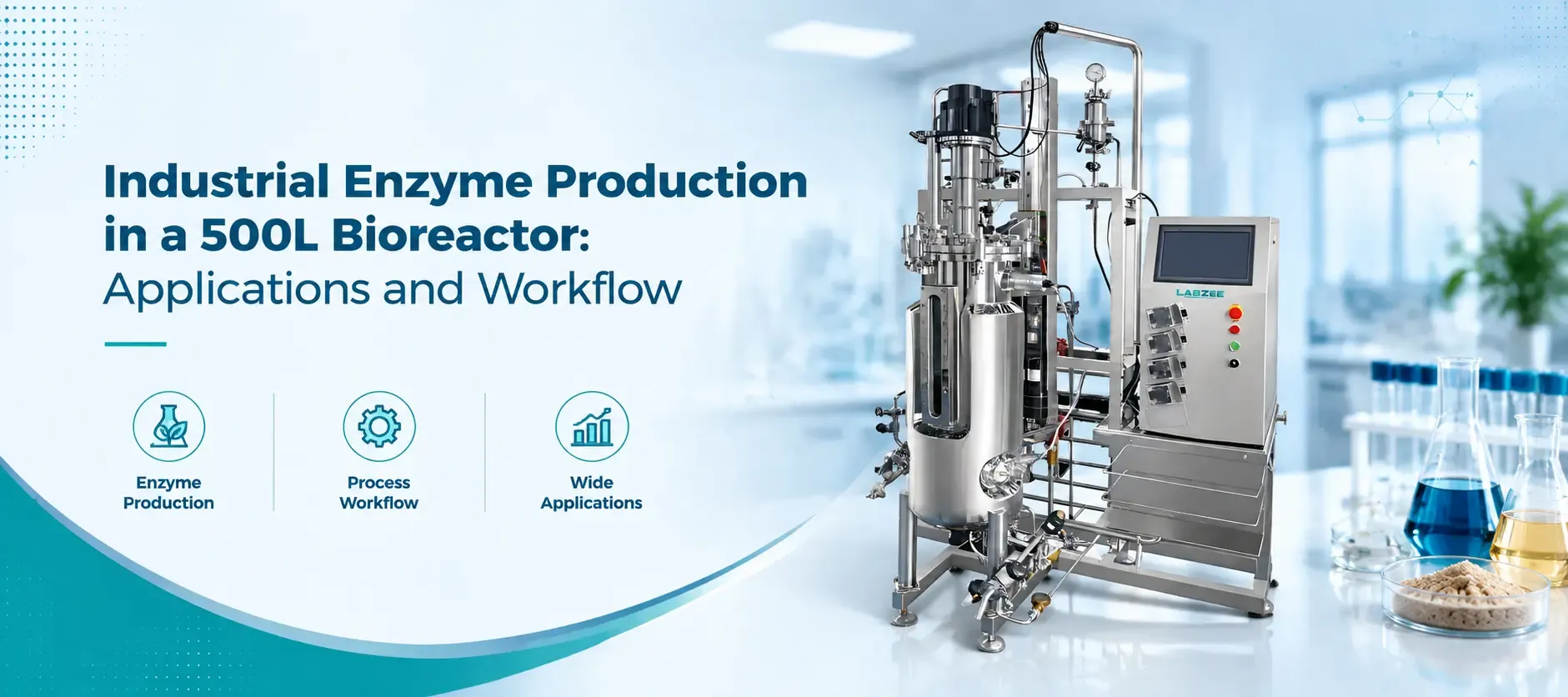
Scaling enzyme production from the bench to a pilot batch means moving into a vessel built for controlled, repeatable fermentation. This guide explains how a 500-litre Stainless Steel Bioreactor BZLB-508 supports industrial enzyme work, walking through the process, the applications it serves, and the design points that shape a run.
A stainless steel bioreactor gives microorganisms a controlled space to grow and secrete the enzymes a process needs. The vessel holds a sterile broth of nutrients while an agitator mixes the culture, a sparger feeds air or oxygen, and jacketed walls hold temperature steady. Probes track pH, dissolved oxygen, and temperature so conditions stay inside the narrow band where the organism produces enzyme efficiently. A stainless steel reactor vessel suits this work because its surface withstands repeated steam sterilisation and aggressive cleaning without degrading.
At 500 litres, a steel bioreactor bridges laboratory development and full production, letting a team confirm that a strain behaves the same at scale as it did in a flask. Because the culture is living, small shifts in mixing or aeration change the yield, which is why a stainless bioreactor pairs close control with a geometry that keeps the whole volume uniform.
Stainless steel bioreactor diagram: agitator, sparger, jacket, and probe ports on a 500L vessel
Add a labelled cross-section of the vessel internals and utility connectionsAn enzyme batch follows a defined sequence, and each stage sets up the next. Following the flow shows where the bioreactor fermenter does its work and why control at each point matters.
Nutrients, carbon and nitrogen sources, and salts are mixed to the recipe the strain needs, then charged to the vessel.
The vessel and media are steam-sterilised in place so the culture starts free of competing organisms.
A seed culture, often grown in a smaller vessel, is transferred in to start the batch with an active population.
Agitation, aeration, temperature, and pH are held to setpoints while the organism grows and secretes enzyme over hours to days.
The broth is cooled and sent downstream for separation and purification, leaving the vessel for a clean-in-place cycle before the next batch.
Enzymes made at this scale feed a range of industries, and the same vessel can move between products with a cleaning and media change.
Amylases, proteases, and pectinases support baking, brewing, dairy, and juice clarification.
Proteases and lipases raise the performance of laundry and dishwashing formulations at lower temperatures.
Cellulases and related enzymes break down biomass and finish fabrics in place of harsher chemistry.
Specialty enzymes for diagnostics and synthesis are produced in batches sized to demand.
A few design choices decide how well a vessel holds a culture uniform and how simply it cleans between batches. These are the details a stainless steel bioreactor design is judged on in daily use.
Height-to-diameter ratio, impeller type, and baffling govern mixing and oxygen transfer. Confirming stainless steel bioreactor dimensions against floor height and door access avoids an install surprise.
Smooth, drainable internals and well-placed spray balls let steam and cleaning fluids reach the whole surface, which protects one batch from the last.
Integrated probes and a control loop for temperature, pH, dissolved oxygen, and agitation keep the culture in its productive window through the run.
Buyers new to scale-up often focus on volume and overlook the factors that decide whether a batch performs. A few missteps recur.
A larger tank does not ensure the same yield unless mixing and oxygen transfer scale with it. Match agitation and aeration to the culture, not just the litres.
Steam, cooling, clean air, and power all have to meet the vessel's demand. Confirm site services before a stainless steel fermenter is specified.
A vessel that is hard to clean and verify slows changeover between products. Weigh drainability and access alongside capacity.
The BZLB-508 belongs to the wider group of bioprocessing vessels used to grow cultures and make biological products, spanning bench fermenters, pilot-scale tanks, and production units. When teams weigh options in this category, they usually compare working volume, material and finish, sterilisation method, control features, and how cleaning is handled. Because a well-chosen bioreactor has to hold a culture uniform and survive repeated cleaning, buyers look closely at geometry and instrumentation as much as at capacity, and they often ask bioreactor manufacturers for scale-up data before deciding.
You can see how Labzee arranges its instruments across laboratory disciplines on the Labzee home catalogue, and the full set of vessel sizes and configurations is laid out on the bioreactor category page for side-by-side review. Reading across the category first makes it easier to line up working volume, control, and cleaning features with the process a team plans to run.

Teams planning a seed bioreactor stainless steel and single use strategy often weigh the two formats side by side before committing to a train, and the full options sit on the Labzee bioreactor range.
| Consideration | Stainless steel vessel | Single-use bag |
|---|---|---|
| Reuse | Cleaned and run for years | Discarded after a batch |
| Scale | Suits large production volumes | Common at smaller scale |
| Changeover | Clean and sterilise in place | Swap the bag, no cleaning |
| Cross-contamination | Managed by validated cleaning | Avoided by disposal |
| Consumable use | Low ongoing consumables | Ongoing bag supply |




