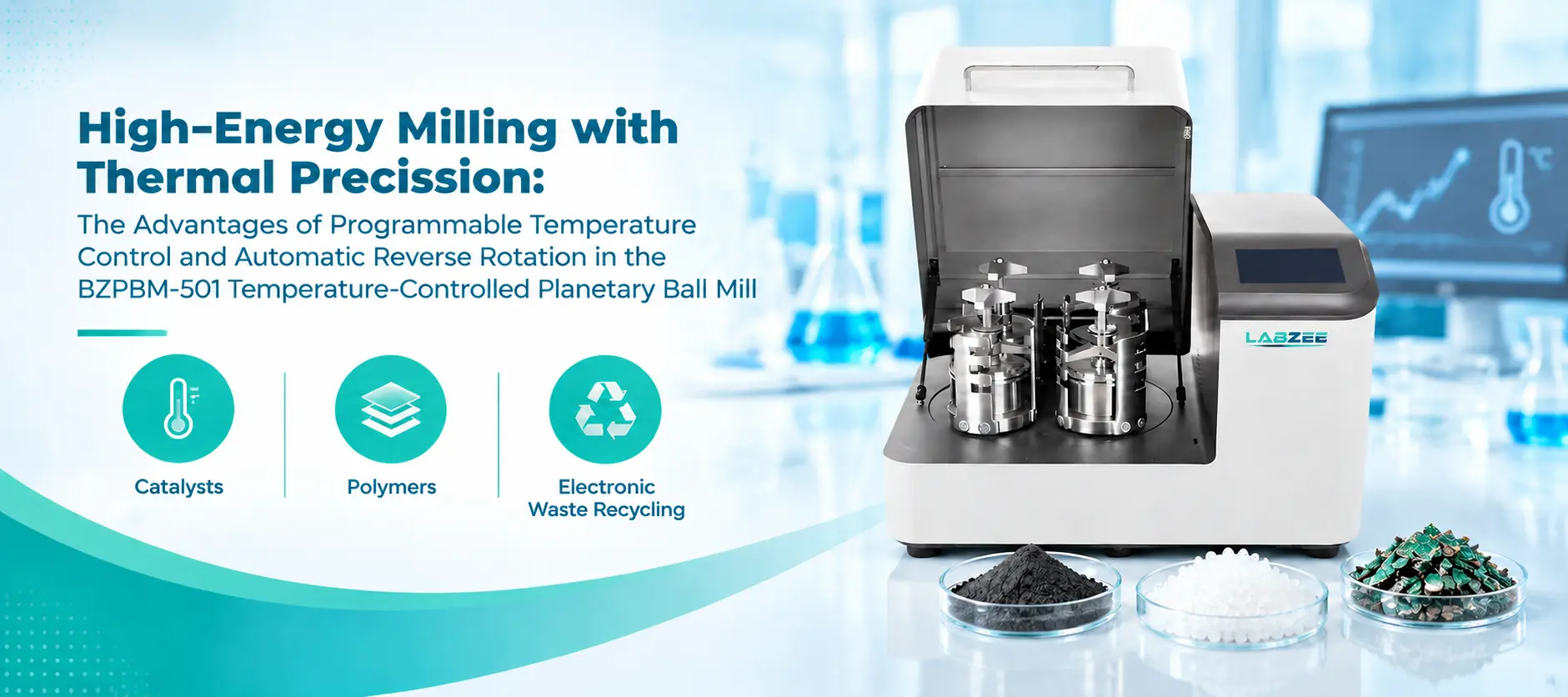
A programmable thermal routine lets an operator define the temperature the grind should stay within, then leaves the instrument to manage it. Rather than a fixed on-or-off cooler, the controller reads a sensor near the jars and adjusts milling and cooling to track a target band, with settable ramp rates, hold periods, and rest intervals across a run. Grasping the temperature-controlled planetary ball mill working principle here means seeing grinding energy and heat removal handled as one loop rather than two separate settings.
The gain is a repeatable thermal history. Because the profile is programmed, the same recipe reproduces the same temperature curve on the next batch, which matters when heat is a variable in the result. This is central to the temperature-controlled planetary ball mill design, where the control logic is as much a part of the instrument as the drive, and it lets a high-energy planetary ball mill run longer without drifting out of range.
A programmed thermal profile the controller follows through the run
Automatic reverse rotation periodically flips the turning direction of the sun wheel, so the grinding balls change the path they trace inside each jar. Left in one direction, media and material tend to settle into a repeating track, packing against one side and caking onto surfaces. Reversing the motion breaks that pattern, redistributing the charge and pushing balls through fresh material each cycle.
Three benefits follow. Grinding becomes more uniform, because no part of the charge is left untouched while another is overworked. Cold welding and caking drop, since material is not pressed into one spot long enough to stick, which keeps the temperature-controlled planetary ball mill balls cleaner and the yield higher. And wear spreads more evenly across media and jar, extending service life. Paired with the thermal routine, reversal also helps move heat around the charge rather than letting it pool at one contact zone.

Programmed temperature and scheduled reversal matter most where a plain grind would compromise the sample or the result.
Reactions driven by milling depend on both energy and temperature. A programmed band keeps the chemistry on course, while reversal spreads the reaction evenly through the charge for a consistent product.
Coatings, feedstock, and dispersions need a narrow size range. Direction changes prevent a fraction from packing untouched, so the output holds a tighter particle distribution.
Polymers and active supports that soften or degrade with heat gain from a held band, letting a laboratory planetary ball mill grind them without crossing a damaging temperature.
Extended grinds that would overheat or cake in a basic unit can run through the night, with the controls managing heat and redistribution while staff is away.
The BZPBM-501 belongs to the wider group of ball mill machines, a category that ranges from simple mixer and tumbling mills up to a high-energy planetary ball mill, with and without programmable controls. When comparing a planetary ball mill machine, buyers usually weigh the number and volume of jars, the choice of media and jar materials, the speed the drive delivers, and whether temperature and rotation can be programmed rather than merely switched on. Available temperature-controlled planetary ball mill sizes, from compact benchtop frames to larger multi-jar units, also shape which model suits a given output, and knowing what a temperature-controlled planetary ball mill used for a given material demands helps narrow the field.
To compare the range, you can browse the full lineup on the ball mill machine category page, which groups models by type and capacity. The mill is one part of a broader instrument catalogue, and the Labzee laboratory equipment homepage sets out the other disciplines the company covers, which helps a buyer plan a milling purchase alongside wider lab needs.
Programmable control and reversal are easy to list on a specification sheet and easy to misjudge in practice.
A fan or jacket that only switches on is not the same as a routine that tracks a setpoint. Ask whether the mill follows a programmed band and logs it, since that is what makes a run repeatable.
Reversal is most useful when its interval and pause are adjustable to the material. A fixed, unchangeable cycle may not suit a sample that cakes quickly, so check how finely the reversal can be tuned.
Programmed control cannot rescue a poor charge. A planetary ball milling machine still needs media and jar materials matched to the sample, and comparing options across the Labzee ball mill machine range helps get that pairing right.
A profile that is held but not logged leaves no evidence for validation. For method work, favour a mill that records the temperature and rotation history alongside the run.
The table sets out what the two automated controls add over a mill that only grinds, so a buyer can judge whether the features fit the work.
| Aspect | Basic planetary mill | Programmable, reversing mill |
|---|---|---|
| Temperature | Rest pauses only | Tracked to a programmed band |
| Rotation | One direction | Scheduled automatic reversal |
| Grind uniformity | Prone to packing | Charge redistributed each cycle |
| Repeatability | Operator-dependent | Recipe reproduces the profile |
| Record | Time and speed | Temperature and rotation logged |