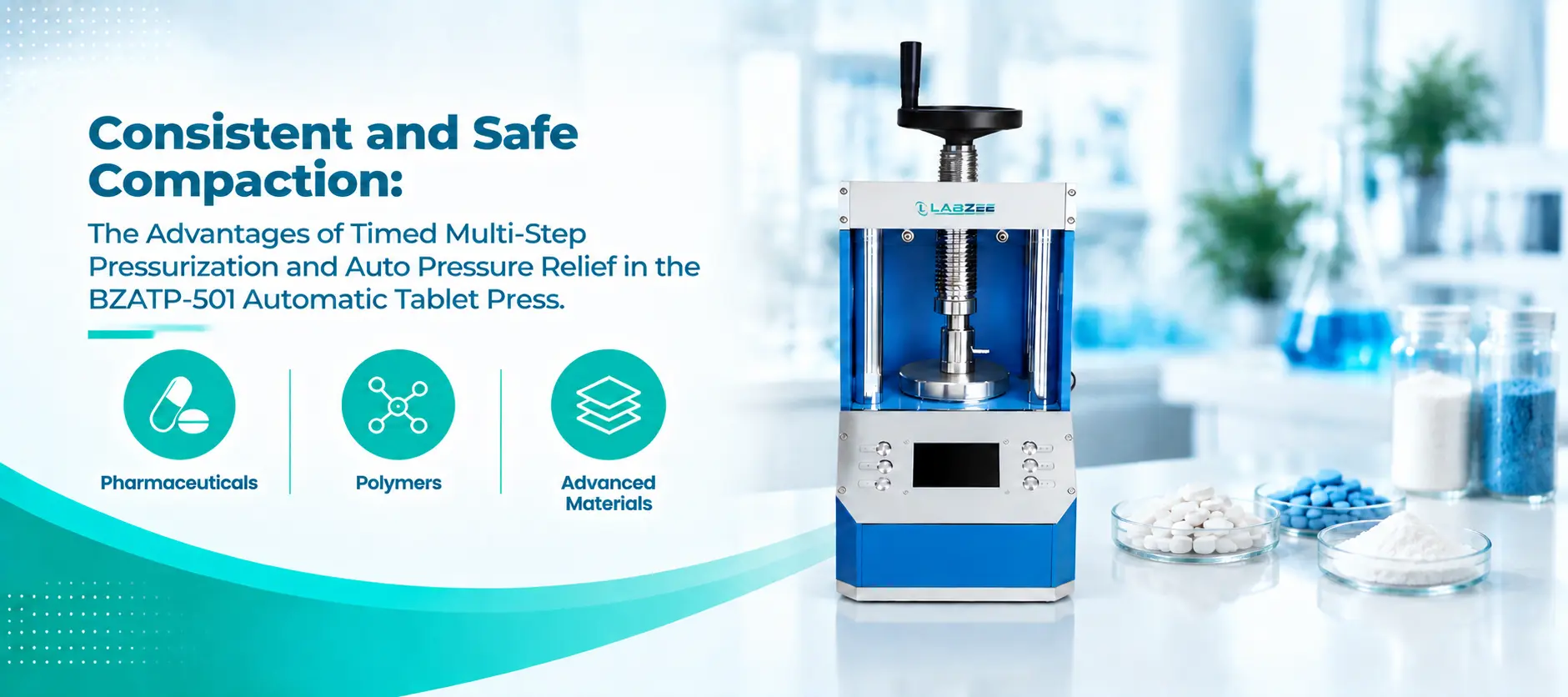
Two tablets pressed to the same peak force can still turn out differently, because how the force is applied and released shapes the result. Air trapped in a powder, elastic recovery after release, and sudden load can all leave a weak or cracked tablet. A staged pressure profile and a controlled release answer that by applying force in timed steps and easing it off rather than dropping it. The Automatic Tablet Press BZATP-501 builds both into its cycle for compaction that stays even and handling that stays safe. This article explains how timed multi-step pressurization and automatic pressure relief work, where they change results in practice, and the points buyers overlook when judging a press on peak force alone.
Timed multi-step pressurization applies the compression load as a programmed sequence rather than a single sharp stroke. The press builds to a first level, holds, then advances to the next, giving trapped air time to escape and the particles time to rearrange and bond before the peak is reached. Each dwell lets the powder settle into a denser, more even packing than a single fast press would leave, so the finished tablet carries fewer internal voids.
The payoff is consistency the mechanics can repeat. Because the steps and hold times are set in the program, an automatic tablet compression machine reproduces the same profile on the next tablet and the next, which is what keeps hardness and thickness within a narrow band across a run. For materials that resist bonding or hold air, this staged approach on a fully automatic tablet making machine often succeeds where one hard stroke would cap or laminate the tablet.
A staged pressure profile with dwell periods between steps
Automatic pressure relief manages the end of the cycle as carefully as the build-up. When compression finishes, the system lowers the load in a controlled way before the tablet is ejected, rather than releasing it all at once. A sudden release lets a compressed powder spring back sharply, and that elastic recovery is a common cause of capping, where the top of the tablet splits away. A gentle release lets the tablet relax gradually and hold together.
The same function guards the operator and the tooling. Relieving stored pressure in a managed sequence means punches and dies are not subjected to a sudden snap, and a jam or overload can be brought down safely rather than held under full force. On a tablet press machine that runs unattended, this controlled let-down is part of what makes a long session both consistent and safe to leave running.

These two controls earn their place wherever a plain press would compromise the tablet or the run.
Fluffy or fine powders trap air that a single stroke seals in as voids. Timed steps vent that air between stages, so an automatic tablet making machine forms a dense tablet instead of a weak, layered one.
Materials that spring back after pressing are prone to capping. A gentle release lets them recover slowly, cutting the split tops that would otherwise scrap part of a batch.
Staged loading spreads the mechanical work over time, easing the local stress and heat a hard single stroke can create, which suits fragile actives and sensitive composites.
Controlled release and safe overload handling let a tablet making machine automatic in its cycle work long sessions with less risk, so staff can step away from the press between checks.
The BZATP-501 belongs to the wider group of tablet presses, a category that spans single-punch bench units, compact desktop models, and multi-station rotary machines. When comparing an automatic tablet press machine, buyers weigh compression force and tablet size, output rate, and tooling, but the pressure profile and safety features increasingly separate one model from another, since they decide how well a difficult powder tablets and how safely the press runs. Compact desktop units marketed as an automatic tablet press for home use sit at one end for supplements and light tasks, while laboratory models add programmable pressure staging, force feedback, and managed relief; a tablet making machine for home preparation and a lab press differ mainly in the control they give over how force is applied.
To see how the range fits together, you can browse the full lineup on the automatic tablet press category page, which groups models by capacity and features. This line is one part of a broader instrument catalogue, and the Labzee laboratory equipment homepage sets out the other disciplines the company covers, which helps a buyer plan a pressing purchase alongside wider lab needs.
A pressure profile and a relief system are easy to list and easy to misjudge against a simple peak-force figure.
The highest tonnage is not the whole story, since a difficult powder often needs the load applied in stages rather than harder. Look at whether the pressure can be profiled, not just how high it reaches.
A basic press simply removes the load, which can cap sensitive tablets. Confirm the machine eases pressure off in a managed way where the material is elastic or fragile.
How a press responds to a jam matters for safety and tooling. A managed relief on overload protects punches and the operator, and comparing options across the Labzee automatic tablet press range on that point is worthwhile.
Without a log of the pressure steps applied, a good tablet cannot be reproduced with confidence. For method work, favour an automatic tablet machine that records the profile it ran, not only the peak it hit.
The table sets out what timed pressurization and managed relief add over a basic single-stroke press, so a buyer can judge whether the features fit the material.
| Aspect | Single-stroke press | Staged, auto-relief press |
|---|---|---|
| Force application | One fast stroke | Timed steps with dwell |
| Trapped air | Sealed as voids | Vented between stages |
| Release | Sudden let-go | Controlled easing off |
| Capping risk | Higher on elastic blends | Reduced by gradual relief |
| Unattended safety | Overload held under force | Managed relief on overload |