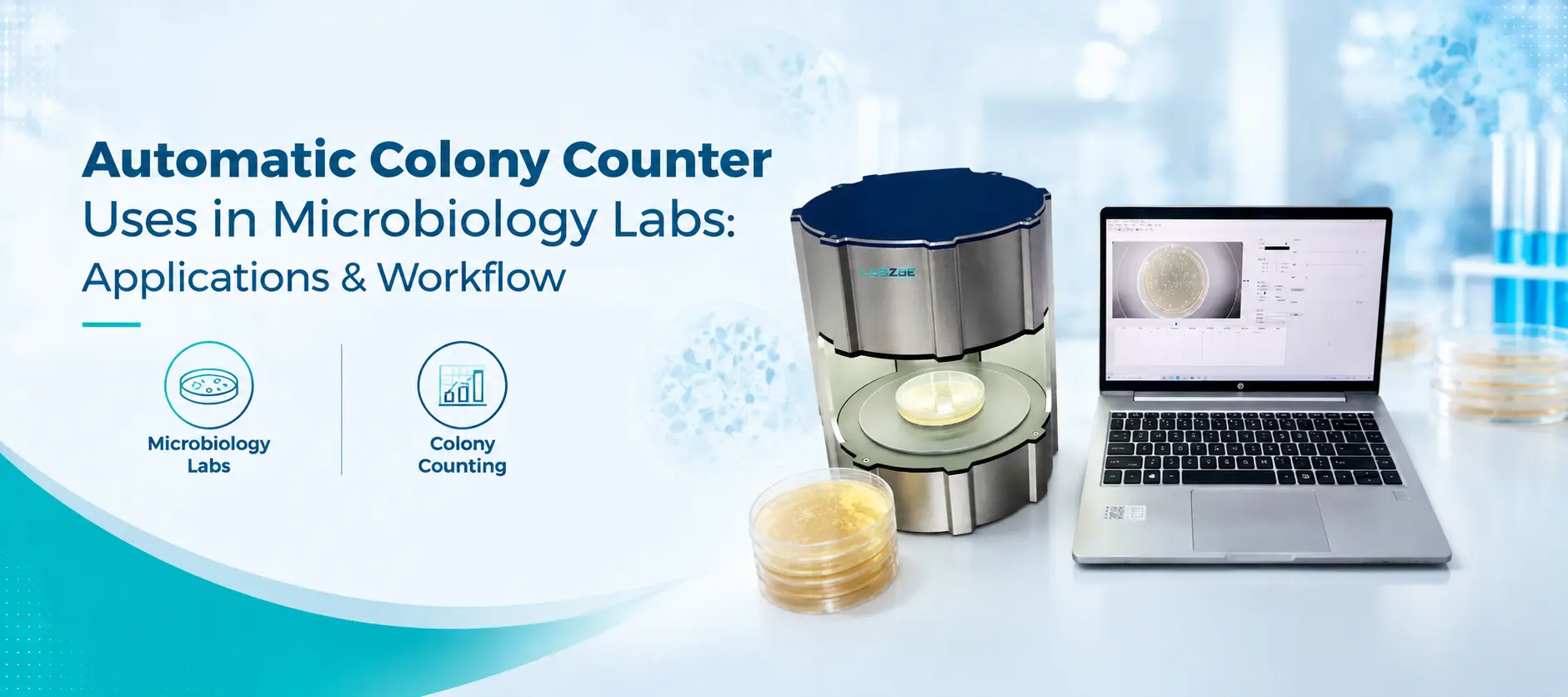
Counting bacterial and fungal colonies on a Petri dish by eye is slow, and the result can shift slightly from one reading to the next depending on who is doing the counting. An automatic colony counter replaces that manual step with an imaging system that reads the whole plate in a single pass. This article walks through how that process works and where it fits into daily microbiology lab workflow, using the Automatic Colony Counter BZAT-501 as a working example.
The BZAT-501 captures the plate through a 4K ultra-high-definition imaging system paired with dual 360° LED illumination, which lights the dish evenly from multiple angles rather than leaving one side in shadow. Image processing software then analyzes the captured frame to distinguish individual colonies from the plate background and from each other, a process this automatic colony counter machine completes in under one second per plate.
Detection sensitivity is specified down to a smallest detectable colony size of 0.1mm, and the imaging system covers standard 55mm and 90mm dishes as well as larger dishes up to 120mm. Adjustable LED brightness lets the operator compensate for plates with denser or lighter growth before the count runs.
Automatic colony counter diagram: dish placement, LED ring illumination, and imaging path to the counting software
Add a labelled diagram showing plate placement, illumination angle, and camera pathA manual colony counter is really just a marker pen and a handheld tally device used against a lit background, and it depends entirely on the operator's attention holding steady across the full batch of dishes. An auto colony counter instead applies the same imaging and detection settings to each plate in turn, which is most valuable in high-throughput settings running many plates through a shift, since the counting step itself no longer scales with operator fatigue.
Shoppers comparing options in this category often search by brand name as well as by feature, including terms like colony counter interscience or automatic colony counter interscience for a specific competing manufacturer's line; Labzee's own colony counter category page lists the BZAT-501's specifications directly for buyers comparing across brands on imaging resolution, dish compatibility, and counting speed rather than name alone.
Hospital-based clinical microbiology sections and standalone research institutions both run comparable plate-counting workflows, which is why an automatic colony counter in microbiology settings tends to serve diagnostic and research labs equally well once dish compatibility and throughput needs line up with the model chosen. The same holds for an automated colony counter in microbiology programs focused on environmental or food-safety monitoring rather than clinical diagnostics.

| Specification | Value |
|---|---|
| Counting speed | Under 1 second per plate |
| Dish compatibility | 55mm & 90mm standard, up to 120mm maximum |
| Camera resolution | 8.29 megapixels (5M/8M/10M options) |
| Smallest detectable colony | 0.1mm |
| Lighting | Dual 360° LED, adjustable brightness |
| Dimensions (W×D×H) | 290 × 260 × 380 mm |
| Weight | 3 kg |
| Power supply | AC 100V–240V, 50Hz |
| Housing material | ABS plastic |
| Data export | USB export; Excel and PDF report formats |
The Labzee colony counter category page groups plate-counting instruments by imaging resolution, dish compatibility, and counting speed, the same factors covered in this article's specifications. Colony counters sit within Labzee's wider catalog of laboratory instruments, spanning glassware washers, temperature and humidity chambers, and autoclave sterilizers, all viewable from the Labzee home page for labs equipping more than one department.




