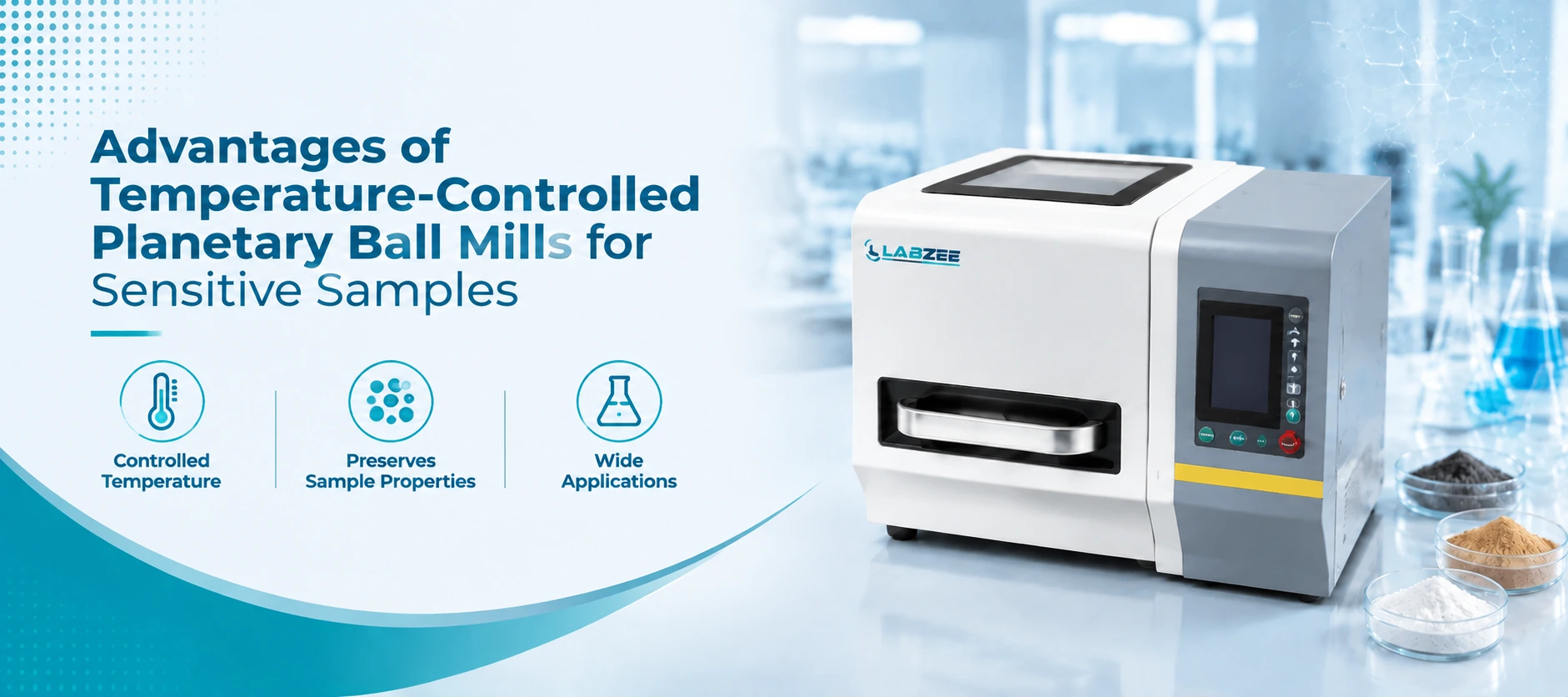
High-energy grinding turns mechanical work into heat, and for delicate material that heat is the difference between a usable powder and a spoiled one. This guide explains how holding temperature in check protects heat-sensitive samples during milling, and why it matters for both yield and repeatable results, with the Advanced Nano Planetary Ball Mill BZABM-501 as a reference point throughout.
Inside a planetary mill, grinding balls strike and shear the sample thousands of times a minute. That impact and friction reduce particle size, but they also convert energy into heat, and the temperature inside a sealed jar can climb well above the surroundings during a long run. For rugged minerals this rarely matters; for delicate material it can be the limiting factor.
Localised hot spots at the point of impact are hotter still than the bulk reading suggests. When a sample softens, oxidises or changes phase at those points, the finished powder no longer represents the starting material, so the analysis that follows is built on shifted ground. Temperature control exists to keep the sample within the range where it stays intact.
Diagram: heat rising through a grinding cycle against a controlled setpoint band
Add a plot of jar temperature over time, uncooled versus controlledA planetary ball mill for laboratory use manages heat through a mix of timing, cooling and energy control rather than one single feature.
Timed grinding periods separated by rest let generated heat dissipate before the next cycle starts.
Air or liquid cooling around the jars carries heat away during longer runs, holding the sample near a set range.
Programmable direction reversal and adjustable speed spread the energy input and limit local hot spots.
Used together on a planetary ball milling machine, these controls let an operator push toward a fine or nano-scale result without letting the sample overheat along the way.
Some sample types tolerate warm milling; others react to a few degrees. These are the groups where temperature control changes the outcome most.
Heat can shift crystal form or degrade an active ingredient, altering potency and dissolution behaviour.
Softening near the glass transition makes polymers smear rather than fracture, blurring particle size.
Enzymes, proteins and nutrients lose activity as milling heat climbs, so results drift from the native sample.
Certain phases transform or oxidise with heat, so a cool cycle preserves the structure under study.
The first advantage is sample integrity. When the powder never leaves its safe range, its crystal form, potency and biological activity survive the grind, so what reaches the instrument matches what went into the jar. That protection is the reason a laboratory planetary ball mill with cooling opens up materials that heat-tolerant grinding cannot handle.
Steady temperature also sharpens the powder itself. Cool milling avoids the softening and re-agglomeration that widen a size distribution, which helps a nano ball mill reach a narrow, repeatable nano range. Because the thermal history is the same from run to run, batch-to-batch variation shrinks and logged conditions give a record to explain any outlier, turning one clean result into a repeatable method.
Even a capable mill can cook a sample when the thermal side of the setup is treated as an afterthought. A few missteps recur.
Back-to-back grinding with no rest drives temperature up quickly. Build in intervals sized to how the material responds to heat.
Dense media and small jars warm fast. Match the media charge and jar size to the thermal budget of the sample, not only to the target size.
Settings that stay cool in a small jar can overheat a larger one, since heat leaves a bigger volume more slowly. Re-check temperature whenever the batch grows.
The jar wall lags the hot spots at the point of impact. Allow a margin so the real peak stays within the sample's safe range.
The Advanced Nano Planetary Ball Mill BZABM-501 belongs to a wider family of grinding and mixing equipment, from bench planetary mills through mixer, vibratory and roller units. When teams weigh options in this category, cooling and interval control now sit alongside jar capacity and station count, media and jar materials, the span of the speed control, and bench footprint, because a mill that cannot manage heat rules out a whole class of samples.
You can see how Labzee arranges its instruments across laboratory disciplines on the Labzee home catalogue, while the full set of sizes and cooling configurations is laid out on the ball mill machine category page for side-by-side review. Comparing the range first makes it easier to line up thermal control with the material a team plans to run.

A short comparison shows why thermal management shapes results before capacity does, whether a team keeps an uncooled unit or plans a cooled setup from the Labzee ball mill range.
| Consideration | Uncooled run | Temperature-controlled run |
|---|---|---|
| Peak temperature | Rises through the cycle | Held near a set range |
| Sample integrity | Risk of degradation or phase change | Structure and potency preserved |
| Particle size | Smearing and re-agglomeration | Cleaner, narrower distribution |
| Repeatability | Varies with ambient and run length | Consistent from batch to batch |
| Suitable samples | Heat-tolerant material only | Includes heat-sensitive material |




