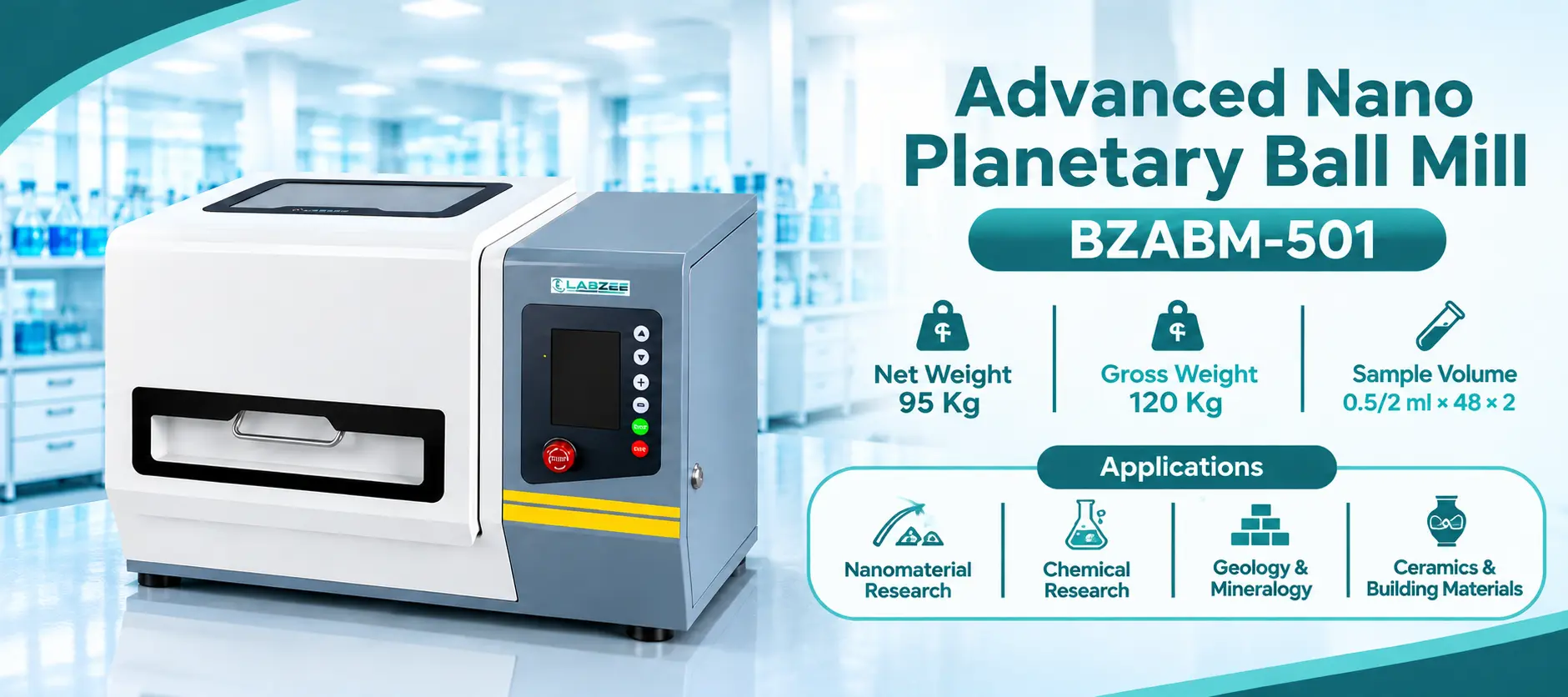
How Planetary Motion Produces Fine Powders
A planetary ball mill places grinding jars on a rotating disc, often called the sun wheel. While the disc turns, each jar spins in the opposite direction on its own axis. The combined motion throws the milling media across the jar and against its wall, so the powder is struck, pressed and sheared many times each minute. The Advanced Nano Planetary Ball Mill BZABM-501 applies this principle in a compact format, and its listed details can be reviewed on the BZABM-501 product page.
Three effects act together inside the jar. Impact fractures brittle particles, friction between balls and wall shears them further, and in ductile metals repeated cold welding and fracturing blends different elements at a fine scale. That last effect is the basis of mechanical alloying, and it explains why a high energy ball mill can produce materials that simple grinding cannot.
Research Areas That Rely on Ultrafine Milling
A laboratory planetary ball mill is used wherever particle size, surface area or intimate mixing affects the property being measured. Each field below uses the same motion for a different purpose.
Nanomaterials & Nanoparticle Synthesis 🧪
Top-down synthesis reduces bulk powders towards the nanometre range. A nano ball mill can also drive solid-state reactions, which gives groups an alternative to wet chemical routes.
Battery Research 🔋
Cathode and anode powders, conductive additives and solid electrolyte candidates are milled to adjust particle size and mixing uniformity before electrodes are coated and tested.
Advanced Ceramics 🏺
Fine, narrow-distribution ceramic powders sinter more evenly. Milling also breaks agglomerates in oxide and carbide powders before forming and firing.
Mechanical Alloying ⚗️
Metal powders are combined without melting, which suits systems where elements mix poorly in the liquid state or where a fine microstructure is wanted.
Catalysts & Pharmaceutical Research 💊
Milling increases surface area for catalyst supports and early formulation studies, where particle size influences how a drug dissolves and how the powder handles.
Shared Research Facilities 🏛️
Core laboratories often serve several groups from one lab ball mill, each with different powders, so jar options, easy cleaning and programmable run settings matter more than a single fixed recipe.
Milling Parameters That Shape the Outcome
Two laboratories using the same ball mill grinder laboratory setup can obtain different powders because of the settings they choose. Anyone operating an advanced nano planetary ball miller should record these variables for each run.
Heat, Contamination and Safe Handling
Fine powders behave differently from bulk material, and the milling step introduces its own risks. Three issues come up most often in practice.
- Heat build-up can change phases, soften polymers or trigger reactions. Intermittent operation and cooling periods keep temperature in check.
- Media and jar wear adds traces of iron, zirconium or tungsten to the powder. Matching jar and media to the sample, and running a blank test, shows how much is picked up.
- Reactive or fine metal powders can ignite or oxidise. Open jars only after they cool, work in a ventilated space or glove box, and wear suitable protection.
Selection Mistakes Labs Often Make
Choosing a laboratory ball mill on a single figure tends to cause trouble once real samples arrive. These patterns appear most often during evaluations.
- Comparing maximum speed alone and ignoring how advanced nano planetary ball mill design affects jar clamping, balance and vibration during long runs.
- Overlooking the finish and fit visible in advanced nano planetary ball mill manufacturing, such as jar sealing and lid closure, which affect wet milling and inert gas work.
- Buying one jar material and later finding that it contaminates sensitive samples.
- Skipping programmable features such as run time, rest intervals and direction reversal, which protect heat-sensitive material.
- Ignoring bench load, noise, floor vibration and ventilation needs until installation day.
- Judging a model without reviewing the range of advanced nano planetary ball mill models against the sample sizes and materials the lab handles.
Mortar, Tumbling Mill and Planetary Mill Compared
The table shows how three common size-reduction approaches differ in a research setting.
| Aspect | Hand mortar | Tumbling ball mill | Planetary ball milling machine |
|---|---|---|---|
| Energy input | Low, manual | Moderate | High, from counter-rotation |
| Achievable fineness | Coarse to fine | Fine | Fine to ultrafine |
| Mechanical alloying | Not suitable | Limited | Well suited |
| Run control | Operator dependent | Basic timer and speed | Programmable speed and time |
| Sample volume | Very small | Larger batches | Small to medium batches |
| Atmosphere options | Open air | Limited | Sealed jars, inert gas possible |
Understanding the Planetary Milling Category
Planetary ball milling equipment covers a family of laboratory mills that differ in jar capacity, drive configuration, speed range, control features and the jar materials they accept. Buyers usually compare sample volume, final fineness, control and display options, jar and media choices, noise, footprint and service access.
The complete advanced nano planetary ball milling category shows how these attributes differ between models, and more about the supplier is available on the Labzee home page.
Putting a Milling Workflow Together
Start with the material and the target particle size, choose the jar and media that suit it, and set a conservative programme with rest periods. Record each run, then adjust one variable at a time. With an advanced nano planetary ball milling machine, laboratories that follow this order reach repeatable powders faster and spend less time tracing unexpected results.
Sophia Parker
Laboratory Equipment Technical Writer
BIO: Sophia Parker develops technical and content focused on laboratory equipment, scientific applications, and laboratory workflows. Her work involves researching equipment functions, applications, specifications, and practical laboratory use cases.
Areas Covered: Laboratory Equipment • Scientific Applications • Technical Research • testing equipment • Scientific Content
https://www.linkedin.com/in/sophia-parker-46770243b